Hormonal birth control is one of the most common medicines women use. In 2017–2019, 65.3% of U.S. women aged 15 to 49 were using a method of contraception, and 14.0% were using birth control pills.74 There is clinical evidence that hormonal birth control affects some women’s mood, but its link with depression has been hard to pin down.64 The honest answer is mixed: some large studies find a link with depression, others don’t, and most people who use hormonal birth control do not develop depression.64,68,69 This article walks through what the evidence does and doesn’t show, so you can have an informed conversation with your clinician.
What the largest studies found
Denmark: depression
A nationwide study in Denmark followed women and teens aged 15 to 34 from 2000 to 2013 who had no prior depression diagnosis or antidepressant use.64 It looked at whether they later started an antidepressant or were diagnosed with depression at a psychiatric hospital.64
In a Danish study of more than 1 million women aged 15 to 34, those using combined birth control pills were more likely to start an antidepressant than nonusers (relative risk 1.23, or about 23% higher); among teens aged 15 to 19 the relative risk was 1.8.64 Users of the progestin-only pill, the patch, the vaginal ring, and the hormonal (levonorgestrel) IUD also had higher relative risks than nonusers.64 The relative risk of starting an antidepressant peaked about 6 months after starting hormonal birth control, and risks generally went down with age.64
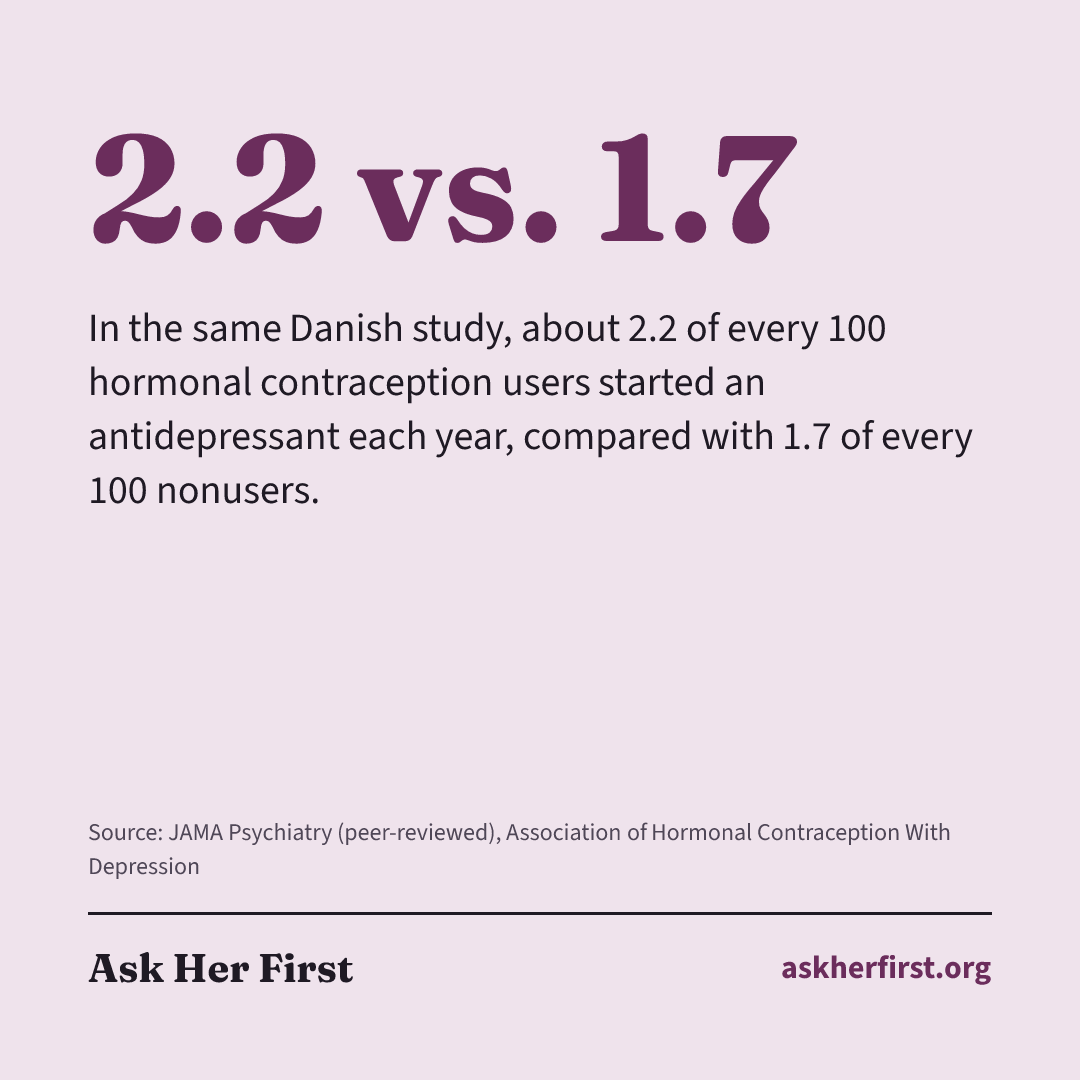
Relative risk is not the same as your personal chance. In the same Danish study, about 2.2 of every 100 hormonal contraception users started an antidepressant each year, compared with 1.7 of every 100 nonusers.64 In other words, most users in both groups did not start an antidepressant in a given year.64
Denmark: suicide attempts
The same research group then studied young women in Denmark who turned 15 between 1996 and 2013 and had no earlier psychiatric diagnosis.65 A Danish study that followed nearly half a million young women found that current and recent users of hormonal contraception had about twice the rate of a first suicide attempt as women who had never used it (relative risk 1.97); 6,999 first suicide attempts and 71 suicides occurred during the study.65 The link with a first suicide attempt peaked after 2 months of use, and teens had the highest relative risk.65
Women in the study were followed for an average of 8.3 years, and the authors reported that hormonal birth control use was associated with later suicide attempts and suicide; an association like this does not prove that birth control caused them.65 If you or your teen notice mood changes after starting a method, especially in the first months, raise it with a clinician.
The United Kingdom: the first 2 years
In a UK Biobank study of 264,557 women, the first 2 years of birth control pill use were linked with a higher rate of depression than never using the pill (hazard ratio 1.71), and the link was weaker after that.66 Women who had used the pill as teens also had a somewhat higher rate of depression later, while there was no significant link among adult pill users who had used it before.66 The authors compared sisters to account for shared family factors and said their results were consistent with the pill causing depression in some users.66
Pooling the studies
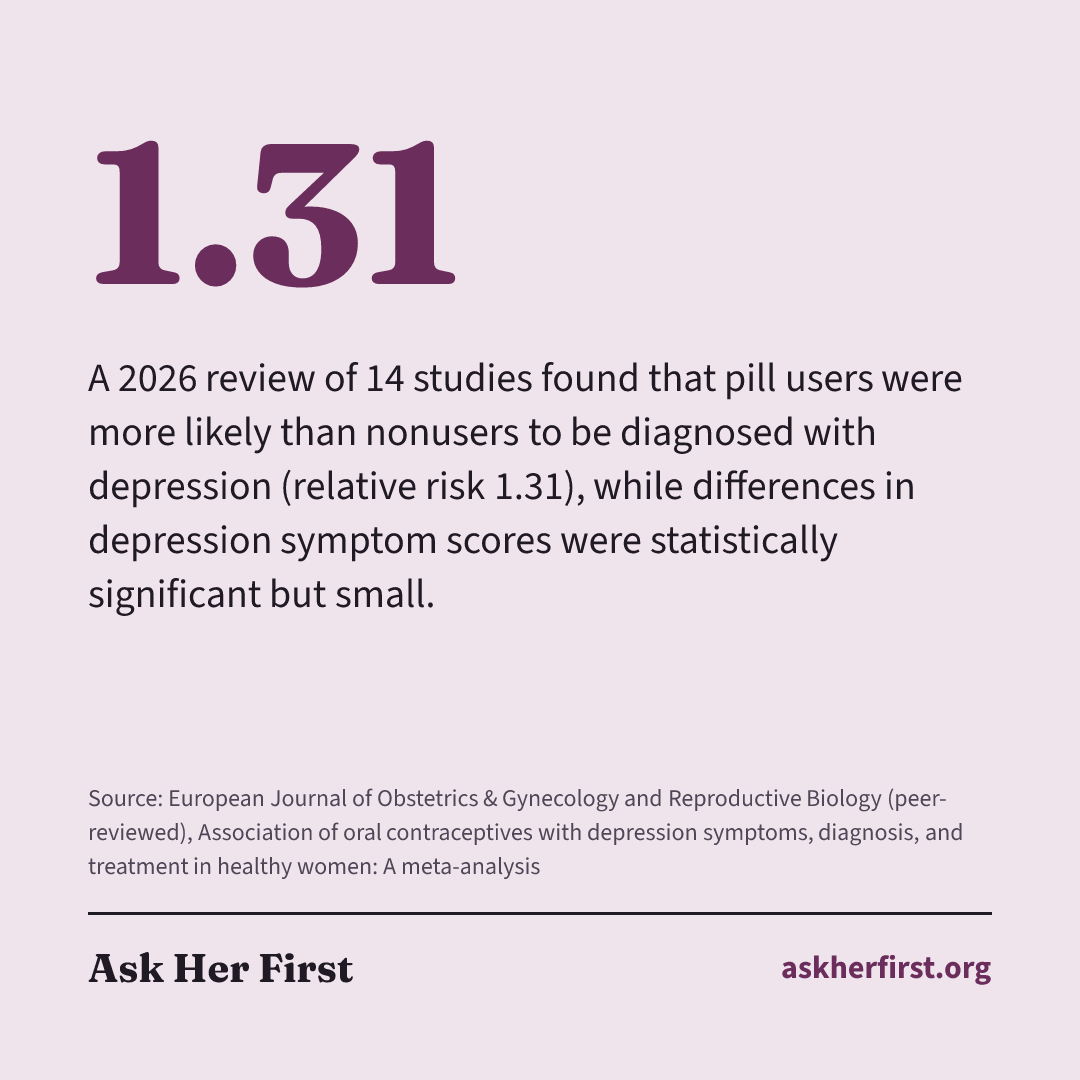
A 2026 review of 14 studies found that pill users were more likely than nonusers to be diagnosed with depression (relative risk 1.31), while differences in depression symptom scores were statistically significant but small.67 Results varied a lot from study to study.67
Studies that did not find a link
Other studies, including a randomized trial, did not find a clear link with depression:
- Progestin-only methods. A 2018 review of 26 studies of progestin-only birth control (the implant, the hormonal IUD, the shot, and progestin-only pills) found minimal association with depression, and concluded that most of the evidence does not support a link based on validated depression measures.68
- U.S. teens. A study of U.S. teen girls in a national survey found no link between using birth control pills and depressive disorders.69
- A randomized trial. When healthy women aged 18 to 35 were randomly assigned to a common combined pill or a placebo for 3 months, the pill lowered overall well-being scores, but had no statistically significant effect on depressive symptoms.70
- Women who already have depression. A CDC-led review found limited evidence from six studies that the pill, the hormonal IUD, and the shot did not worsen the course of depressive or bipolar disorders compared with no hormonal method.72
Why a link doesn’t mean it happens to everyone
The largest studies are observational: they follow what happens to people who chose a method rather than randomly assigning it.64,65,66 That leaves room for other explanations:
- Detection. The Danish authors noted that if prescribers watch more closely for mood symptoms in patients they have prescribed birth control, more depression may be detected in that group.64
- Who stays on the pill. People who have mood problems on the pill may stop it, so long-term users can look healthier than average.66 The UK researchers called this “healthy user bias” and designed their study to account for it.66
- Different people, different responses. In one randomized trial, women with past or current mood, anxiety, or eating disorders reported more mood symptoms on a combined pill than on placebo, but women without mental health problems did not.71
Put together, the evidence suggests that hormonal birth control may raise the risk of depression for some people, particularly teens and new users, while most users don’t experience it.64,66,67,68
What official guidance says
CDC. The CDC’s 2024 U.S. Medical Eligibility Criteria for Contraceptive Use rates every method it covers, including copper and hormonal IUDs, the implant, the shot, progestin-only pills, and combined pills, patches, and rings, as category 1 for people with depressive disorders.73 Category 1 means there is no restriction on using the method for that condition.73 The CDC cites evidence that combined pill use was not associated with increased depressive symptoms in women with depression.73 If you take psychiatric medicines or St. John’s wort, the CDC points clinicians to its guidance on drug interactions.73
FDA labeling. Labels for hormonal birth control can include warnings about mood. For example, the prescribing information for one combined pill (Yaz) says women with a history of depression should be carefully observed, and the pill stopped if depression comes back to a serious degree.169 In that pill’s contraception and acne trials, mood changes, including mood swings and depression, were among the most common side effects, though reported by a small share of users.169 That same pill is also FDA-approved to treat premenstrual dysphoric disorder (PMDD) in people who choose it for birth control.169
Birth control still matters
Women with depressive or bipolar disorders are at increased risk for unintended pregnancy.72 If you notice mood changes, the goal is to find a method that works for you, not to go without protection you want. Talk with your clinician before stopping, so you can switch methods without a gap.
What we don’t know yet
- Who is at risk. Researchers can’t yet tell in advance who will have mood side effects, though past mental health problems and younger age have come up in some studies.71,64
- Which methods and doses. Studies differ in which methods they include, and results for progestin-only methods are mixed.68,64
- Randomized evidence. The placebo-controlled trials described here lasted only about 3 months (three treatment cycles).70,71
- Where the data come from. The largest studies come from Denmark and the UK; the U.S. teen study reached a different conclusion.64,66,69
- How much is too much. Some findings are statistically significant but small; the 2026 review described differences in symptom scores as clinically small.67
Questions to ask your doctor
- I’ve had depression or anxiety before. Does that change which method you’d suggest?
- What mood changes should I watch for, and how soon after starting?
- If my mood changes, what are my other options, including non-hormonal methods?
- How do I switch methods without a gap in protection?
- Could any of my other medicines or supplements interact with this method?
- I have bad mood symptoms before my period. Could a particular method help with that?
- Can we set a check-in a few months after I start?
If you ever have thoughts of suicide, you can call or text 988 any time. In an emergency, call 911.
This article summarizes published research and official health information. It has not been reviewed by a clinician and is not medical advice. How we source.