Many women notice mood or body changes before their period. For some, those changes are severe enough to damage work, relationships, and safety every month. That is premenstrual dysphoric disorder (PMDD), a health problem similar to premenstrual syndrome (PMS) but more serious.158 It is a recognized medical condition, and treatment helps most women.163,159
What PMDD is
PMDD causes severe irritability, depression, or anxiety in the week or two before a period starts, and symptoms usually go away 2 to 3 days after the period begins.158 It happens as hormone levels begin to fall after ovulation.158
A recognized diagnosis
PMDD was once listed in an appendix of the DSM-IV, the American Psychiatric Association’s diagnostic manual, as a set of criteria “provided for further study.”162 After reviewing the research, a DSM-5 work group concluded the evidence had matured enough for PMDD to qualify as a full diagnostic category.162 PMDD is now designated as a disorder in the DSM-5.163
How PMDD differs from PMS
PMS is a set of physical or mood changes in the days before a period that happen month after month and affect normal life.160 PMDD causes more severe symptoms than PMS, including severe depression, irritability, and tension.158 It also includes at least one mood-related symptom, and its symptoms are often debilitating.159
Both follow the menstrual cycle. That timing is what separates them from depression and anxiety disorders, whose symptoms are usually present all month, though they may worsen before or during a period.160 Depression and anxiety disorders are the most common conditions that overlap with PMS, so an ob-gyn will want to check for them.160
How common it is
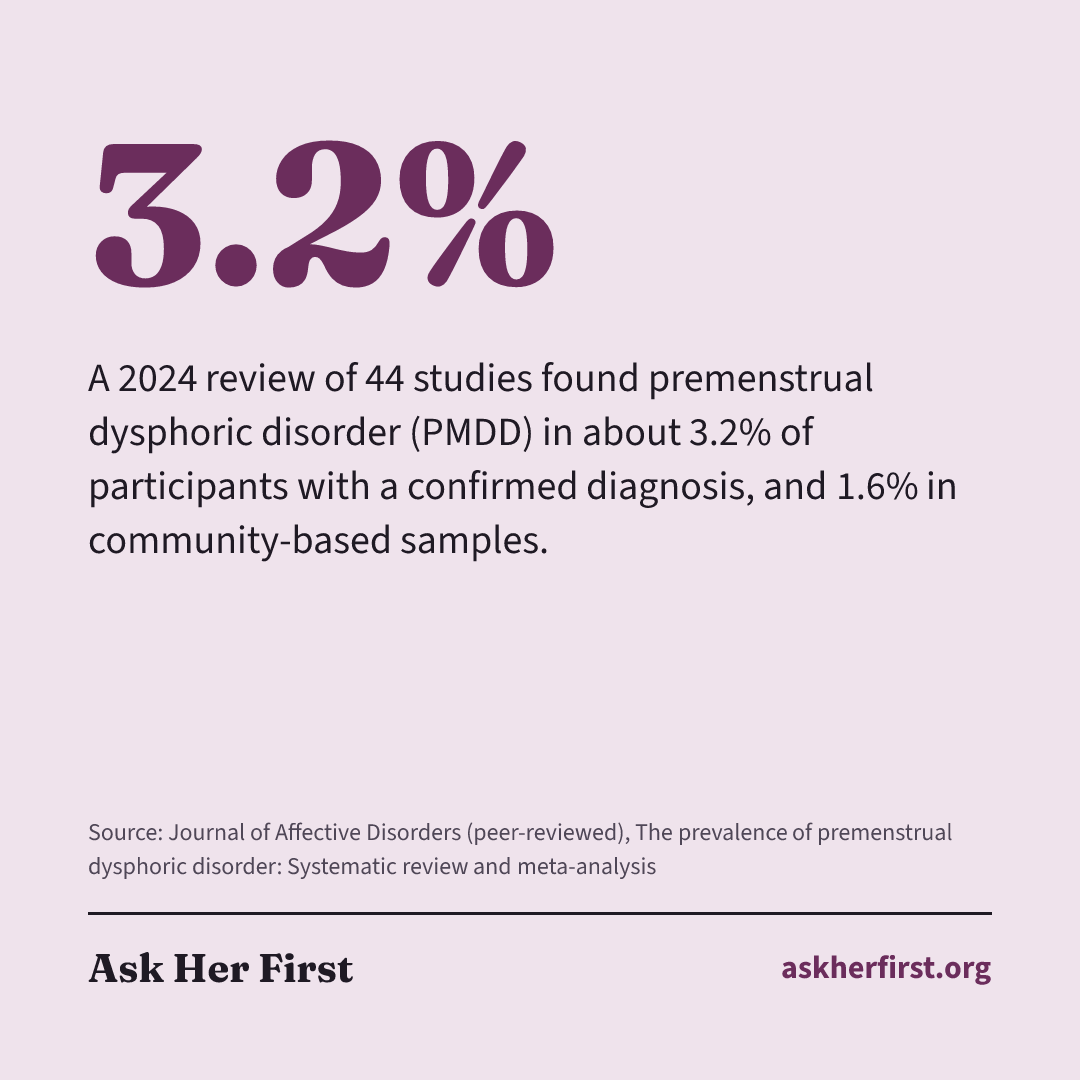
A 2024 review of 44 studies found premenstrual dysphoric disorder (PMDD) in about 3.2% of participants with a confirmed diagnosis, and 1.6% in community-based samples.20 When PMDD was diagnosed without tracking symptoms over two menstrual cycles (a "provisional" diagnosis), a 2024 review found a rate of 7.7%, which the authors say is likely artificially high.20 The gap matters: studies that skip tracking symptoms over two cycles are likely to overcount.20 Many women with PMDD also have anxiety or depression.158
Symptoms
Symptoms of PMDD can include:158
- Lasting irritability or anger that may affect other people
- Feelings of sadness or despair, or even thoughts of suicide
- Feelings of tension or anxiety
- Panic attacks, mood swings, or crying often
- Lack of interest in daily activities and relationships
- Trouble thinking or focusing, tiredness or low energy
- Food cravings or binge eating, and trouble sleeping
- Feeling out of control
- Physical symptoms such as cramps, bloating, breast tenderness, headaches, and joint or muscle pain
PMDD and suicide risk
Several studies link PMDD with a higher risk of suicidal thoughts and behavior.166,167
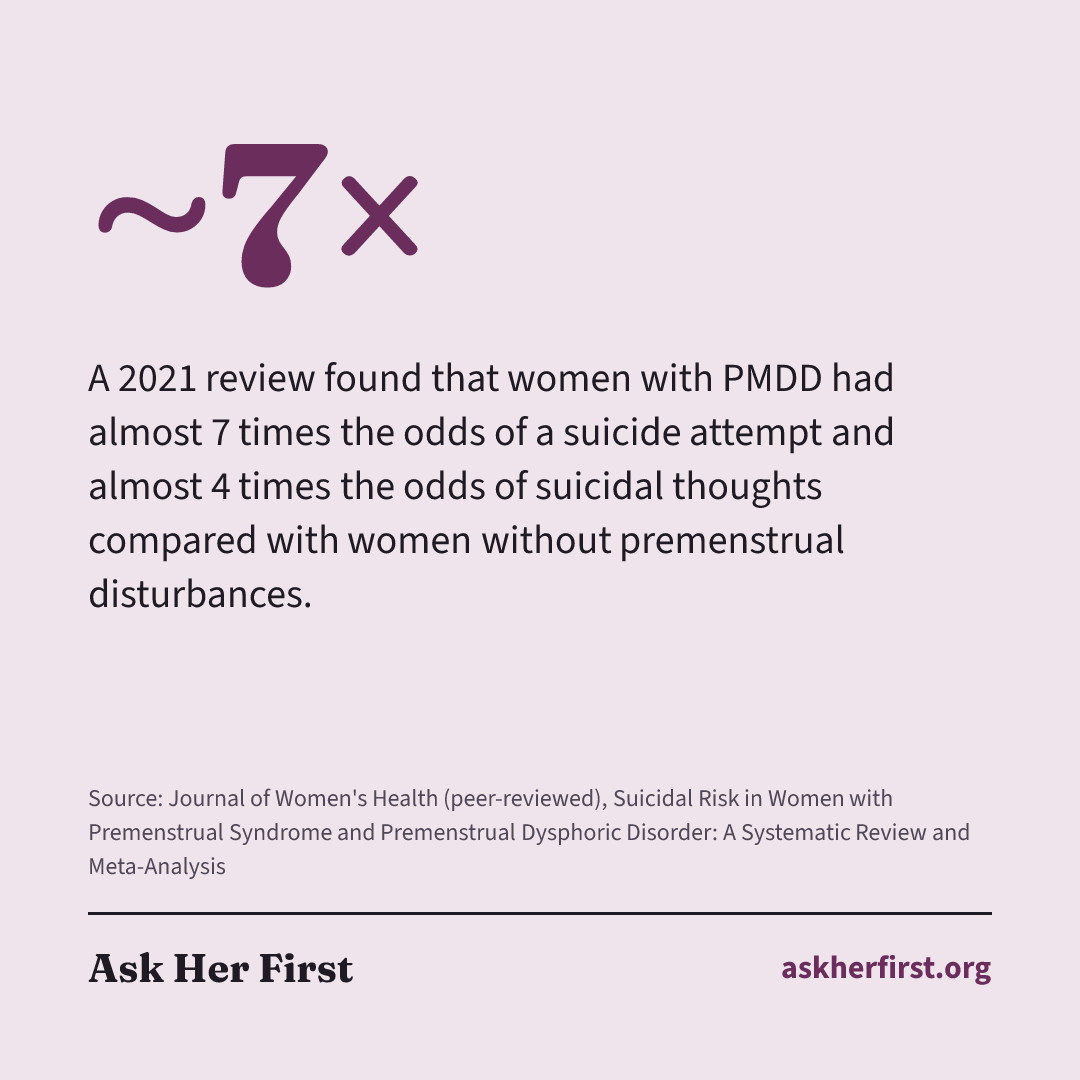
A 2021 review found that women with PMDD had almost 7 times the odds of a suicide attempt and almost 4 times the odds of suicidal thoughts compared with women without premenstrual disturbances.166 A separate 2021 review of six studies (8,532 participants) found that PMDD was linked with about twice the odds of suicidal thoughts, suicide plans, and suicide attempts.167 The two reviews reached different sizes of risk, and the second noted that every study it included used a provisional PMDD diagnosis.167
A study using Swedish national health registers looked at deaths. In a Swedish study of 67,748 women with clinically diagnosed premenstrual disorders, the risk of death by suicide was about 1.9 times that of matched women without them, although their overall risk of early death was not higher.168 Women diagnosed before age 25 had higher risk of early death overall, and the authors called for suicide prevention strategies for all women with premenstrual disorders.168
The authors of the first review said their findings support routine suicide risk assessments for women with moderate-to-severe premenstrual symptoms.166 If you have thoughts of suicide, before your period or any time, you can call or text 988, and in an emergency call 911.159
What causes it
Researchers do not know for sure what causes PMDD.158 Hormonal changes across the menstrual cycle may play a role, and so may serotonin, a brain chemical whose levels change during the cycle; some women may be more sensitive to these changes.158
A study led by NIH researchers, published in 2025, supports the sensitivity idea. When hormones were switched off with medication, PMDD symptoms stopped cycling; when estradiol or progesterone was added back, symptoms returned in women with PMDD but not in women without it.164 The researchers said the underlying mechanism still needs more study.164
How PMDD is diagnosed
No physical exam or lab test can diagnose PMDD.159 Instead, a clinician will ask about your health history, do a physical exam, and ask you to keep a calendar or diary of your symptoms.158 A confirmed diagnosis requires tracking symptoms as they happen over two menstrual cycles; without that, the diagnosis is only provisional.20 To be diagnosed, you must have five or more PMDD symptoms, including one mood-related symptom.158
Thyroid testing and a psychiatric evaluation can help rule out other conditions.159
A simple way to track: ACOG’s advice for premenstrual symptoms is to write down and rate any symptoms each day for at least 2 to 3 months, and record the dates of your periods.160
Treatment options
In 2023, ACOG published a clinical guideline on managing PMS and PMDD. It covers medicines (hormonal and nonhormonal), psychological counseling, complementary treatments, exercise and nutrition, education and self-help, and surgery, and notes that many patients may benefit from combining several approaches.161
SSRI antidepressants. The FDA has approved three SSRIs to treat PMDD: sertraline, fluoxetine, and paroxetine.158 A 2024 Cochrane review of 34 randomized trials found SSRIs probably reduce premenstrual symptoms in women with PMS and PMDD (moderate-certainty evidence).165 SSRIs can be taken only in the second half of the cycle or every day; the review found they were probably more effective when taken continuously.159,165 The most common side effects were nausea, low energy, and sleepiness.165
A specific birth control pill. The FDA has approved a pill containing drospirenone and ethinyl estradiol to treat PMDD.158 Its label says it is for women who choose to use an oral contraceptive for birth control, that its effect on PMDD beyond three menstrual cycles has not been evaluated, and that it has not been evaluated for PMS.169 ACOG notes that birth control methods that prevent ovulation may lessen physical symptoms, but not all of them relieve mood symptoms.160
Talk therapy. Cognitive behavioral therapy may be used with or instead of antidepressants.159
Other options. Over-the-counter pain relievers such as ibuprofen, naproxen, and aspirin may help physical symptoms.158 Regular aerobic exercise, eating well, and cutting back on salty and sugary foods may also help some symptoms.158,160 Medicines that suppress the ovaries and ovulation are another option, but they cause side effects similar to menopause.159
After proper diagnosis and treatment, most women with PMDD find their symptoms go away or drop to tolerable levels.159
What we don’t know yet
- The mechanism. Studies show women with PMDD react differently to the same hormones than women without it, but why is still unclear.164
- How common it is in the general population. Only a small number of prevalence studies used full DSM criteria in community settings.20
- Suicide risk estimates. All the studies in one of the suicide-risk reviews relied on provisional diagnoses, and the two reviews’ estimates differ.167
- Independent treatment research. Of the 34 randomized trials in a 2024 Cochrane review of SSRIs for PMS and PMDD, 68% were funded by pharmaceutical companies.165 The Cochrane authors also suspected publication bias and urged caution in interpreting the findings.165
- Supplements. Most studies have shown that supplements such as vitamin B6, calcium, and magnesium do not relieve PMDD symptoms.159
Questions to ask your doctor
- Could my symptoms be PMDD, PMS, or depression or anxiety that gets worse before my period?
- Can you give me a daily symptom chart to track over the next two cycles?
- Should my thyroid be checked?
- Would an SSRI help, and should I take it every day or only in the second half of my cycle?
- Is a birth control pill approved for PMDD a good fit for me?
- Can you refer me to a therapist who offers cognitive behavioral therapy?
- My worst thoughts come before my period. How do we make a safety plan for those days?
This article summarizes published research and official health information. It has not been reviewed by a clinician and is not medical advice. How we source.