If you have chest pain, trouble breathing, or other frightening symptoms and you aren’t sure whether it’s panic or your heart, call 911. The National Heart, Lung, and Blood Institute (NHLBI) says to call 911 any time you think you might be having a heart attack, even if you are not sure.2 Panic attacks can cause physical symptoms that might feel like a heart attack, such as trembling, tingling, or a rapid heart rate.3 Many people with panic disorder first seek treatment at the emergency room for exactly that reason.4
If you already know these episodes are panic attacks, it may help to know that the National Institute of Mental Health (NIMH) says panic attacks themselves are not life-threatening, and the physical symptoms usually resolve with time.3 You can skip ahead to what may help during a panic attack.
When it could be your heart
Many symptoms of a panic attack are also on the list of heart attack symptoms.2,3 NIMH lists a pounding or racing heart, sweating, difficulty breathing, weakness or dizziness, chest pain, and nausea among the physical symptoms of a panic attack.3 NHLBI lists chest pain or discomfort, shortness of breath, sweating a lot for no reason, nausea, light-headedness or sudden dizziness, and a rapid or irregular heartbeat among the symptoms of a heart attack.2 NHLBI also says women having a heart attack are more likely than men to have certain symptoms, including anxiety, and that these can happen with or without chest pain.5
That overlap is why sources say other causes should be checked. The UK’s National Health Service (NHS) notes that most panic attack symptoms can also be symptoms of other conditions, so you may not always be having a panic attack.6 MedlinePlus says other medical disorders must be checked for before panic disorder can be diagnosed, and that disorders related to substance use are also considered because their symptoms can resemble panic attacks.4
If you call 911, NHLBI says an ambulance is the best and safest way to get to the hospital, and advises against driving yourself or letting someone else drive you.2 Being checked and told it wasn’t your heart is not a wasted trip.
Read more: Heart attack symptoms in women
What a panic attack is
NIMH describes a panic attack as a sudden wave of fear or discomfort, or a sense of losing control, even when there is no clear danger or trigger.3 Panic attacks can happen at any time, sometimes even during sleep.3 The NHS describes a rush of intense mental and physical symptoms that can come on very quickly and for no apparent reason.6
Why this happens isn’t fully understood.4 Some researchers think panic attacks are like “false alarms,” in which the body’s typical survival instincts are active too often, too strongly, or both.3 NIMH gives an example of how this can become a cycle: someone might feel their heart pounding, assume they’re having a heart attack, and that fear can feed more panic attacks that seem to come out of the blue.3
Common symptoms
During a panic attack, NIMH says people may have:3
- A feeling of being out of control
- A fear of death or impending doom
- A pounding or racing heart
- Sweating, chills, or trembling
- Difficulty breathing
- Weakness or dizziness
- Tingly or numb hands
- Chest pain
- Stomach pain or nausea
MedlinePlus also lists a feeling of choking, feelings of detachment or unreality, and hot flashes.4
How long it lasts. Sources describe this a little differently. NIMH says a panic attack can last from a few minutes to an hour or sometimes longer.3 MedlinePlus says an attack begins suddenly and most often peaks within 10 to 20 minutes, though some symptoms continue for an hour or more.4 The NHS says most panic attacks last between 5 and 20 minutes, and some have been reported to last up to an hour.6
Panic attack or panic disorder?
Having a panic attack doesn’t mean you have panic disorder. NIMH says an isolated panic attack is not a mental disorder, and not everyone who has a panic attack will develop panic disorder.3
Panic disorder may be diagnosed when someone has repeated, unexpected panic attacks and spends at least 1 month worrying about having more, feeling scared about what the attacks mean, or changing their behavior to try to avoid them.3 Some people with panic disorder significantly change their lives to avoid another attack, and attacks can happen as often as several times a day or as rarely as a few times a year.3 MedlinePlus notes that recalling a past attack can itself trigger a panic attack.4
Some people with panic disorder develop agoraphobia: intense fear or anxiety about places or situations where escape or help might be hard to get if a panic attack happened.3 Panic disorder can also occur alongside other conditions, including depression, other anxiety disorders, post-traumatic stress disorder, cardiovascular disease, respiratory disorders, and thyroid problems, and it is commonly associated with alcohol and substance misuse.3
How common it is, and who it affects
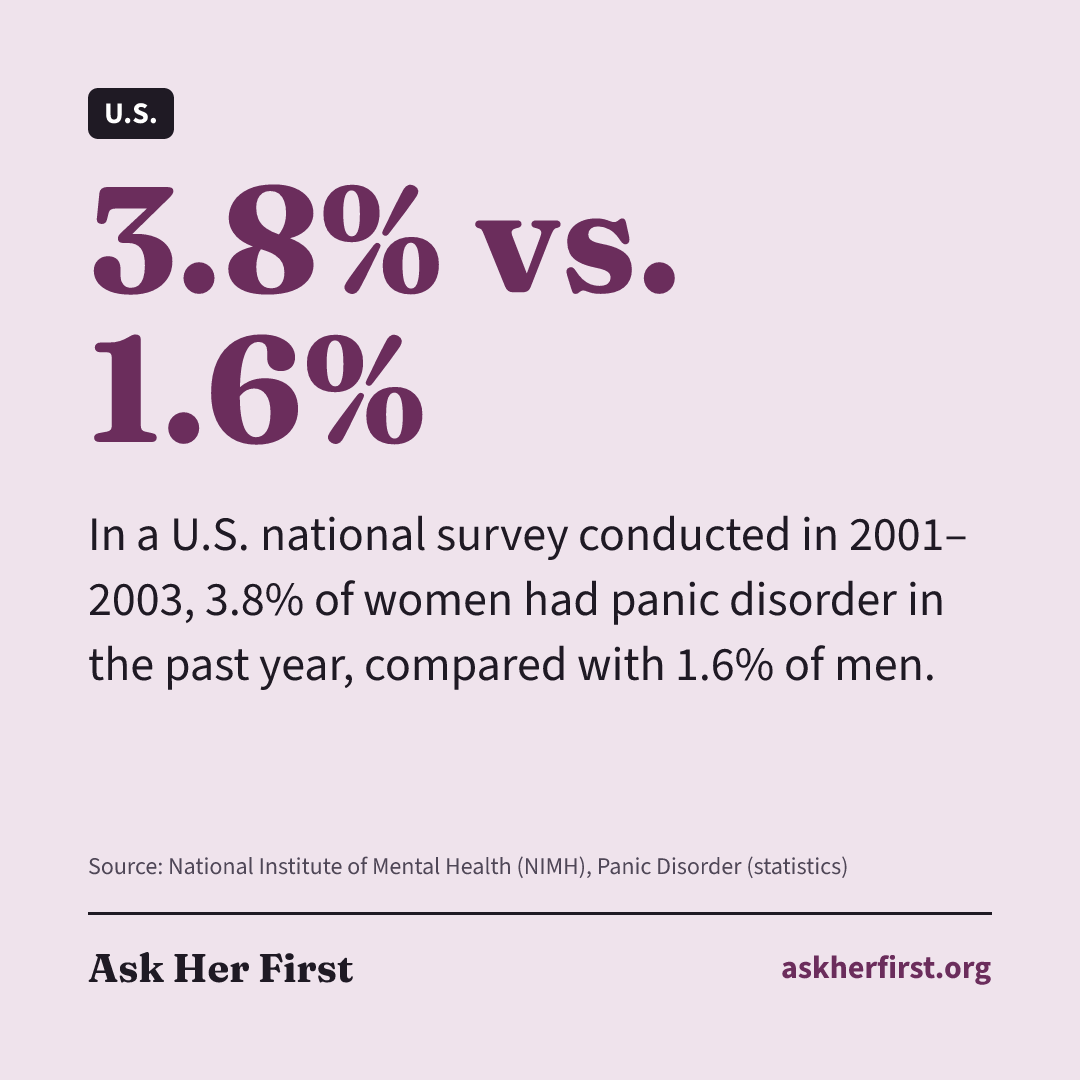
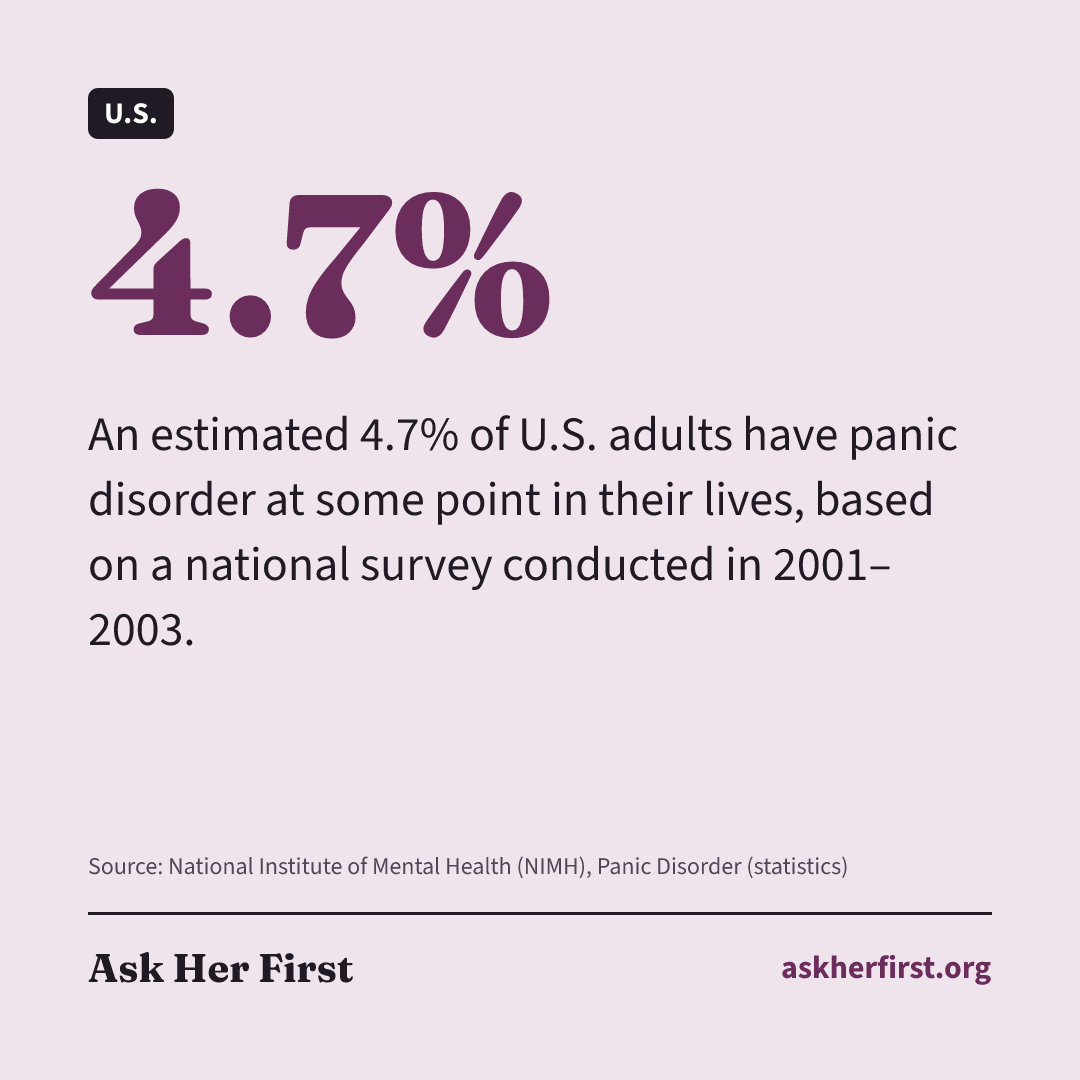
Women are more likely than men to develop panic disorder.3,7 In a U.S. national survey conducted in 2001–2003, 3.8% of women had panic disorder in the past year, compared with 1.6% of men.8 An estimated 4.7% of U.S. adults have panic disorder at some point in their lives, based on a national survey conducted in 2001–2003.8 These are the national figures NIMH publishes, but they come from the National Comorbidity Survey Replication, a household survey carried out between February 2001 and April 2003, so they may not reflect how common panic disorder is today.8
Panic disorder often begins in the late teens or early adulthood.3 MedlinePlus adds that symptoms may first appear in the mid-30s.4
What may help during a panic attack
The U.S. government sources we used focus on diagnosis and treatment rather than step-by-step advice for the moment itself. The NHS, the UK’s national health service, suggests that when you feel a panic attack coming on, you:6
- Stay where you are, if possible
- Breathe slowly and deeply
- Remind yourself that the attack will pass
- Focus on positive, peaceful, and relaxing images
- Remember it’s not life-threatening
That last point applies once you know what you’re dealing with. If the symptoms are new to you, different from your usual attacks, or you’re not sure, treat it as a possible heart problem and call 911.
Learning to respond differently to these sensations is also a core part of treatment. NIMH says exposure therapy may be used along with relaxation exercises and breathing training techniques, and MedlinePlus says cognitive behavioral therapy teaches people to manage stress and relax when symptoms occur.3,4
How panic disorder is treated
Treatment for panic disorder typically involves psychotherapy, medication, or both, chosen based on a person’s needs, preferences, and medical situation.3 Finding the best treatment may take trial and error, and both therapy and medication can take some time to work.3 Sources frame the choice a little differently: MedlinePlus says using both medicines and talk therapy works best, while NIMH describes therapy, medication, or both depending on the person.3,4
Therapy
Cognitive behavioral therapy (CBT) is commonly used to treat panic disorder, and NIMH calls it the “gold standard” choice for psychotherapy.3 CBT teaches different ways of thinking, behaving, and reacting to the feelings that come before or during a panic attack, and attacks can become less frequent once a person learns to react differently to those physical sensations.3 Exposure therapy, a common CBT method, focuses on confronting the fears and beliefs linked to panic symptoms so a person can return to activities they have been avoiding; one technique, interoceptive exposure, involves exposure to the bodily sensations of panic attacks.3 Therapy can be effective in person or by telehealth.3
Medication
NIMH lists several types of medication that health care providers may prescribe for panic disorder:3
- Antidepressants such as SSRIs and SNRIs. They may take several weeks to start working and can cause side effects such as headaches, nausea, or difficulty sleeping, which NIMH says are usually not severe.
- Beta-blockers, which can help control physical symptoms such as a rapid heart rate, sweating, and tremors. NIMH notes they are not commonly prescribed for panic disorder but may help in certain situations that come before a panic attack.
- Benzodiazepines, anti-anxiety sedatives that can quickly reduce panic symptoms. Some people build up a tolerance or become dependent on them, so a provider may prescribe them only for brief periods.
MedlinePlus notes that antidepressant-type medicines for panic disorder are taken every day and advises not stopping them without talking with your provider.4 If you are pregnant or breastfeeding, the Office on Women’s Health says counseling will not affect a pregnancy and suggests talking with your doctor about any medicine, because some medicines used to treat anxiety can affect a baby or pass into breast milk.7
Everyday habits
MedlinePlus says avoiding alcohol, eating at regular times, getting plenty of exercise and enough sleep, and reducing or avoiding caffeine, certain cold medicines, and stimulants may help reduce the number or severity of panic attacks.4 NIMH adds that a healthy lifestyle can help but can’t replace treatment.3
Panic disorder can be long-lasting, but MedlinePlus says most people get better when treated correctly.4 With the right treatment and support, NIMH says, people with panic disorder can manage their symptoms and improve their quality of life.3
When to get help
NIMH says that if anxiety starts to cause problems in everyday life, such as at school, at work, or with friends and family, it’s time to seek professional help.3 MedlinePlus suggests contacting a provider if panic attacks are interfering with your work, relationships, or self-esteem.4
A primary care provider is a good place to start: NIMH says they can refer you to a mental health professional such as a psychologist, psychiatrist, or clinical social worker.3 The provider may ask when your symptoms began, how long and how often they happen, and how they affect your life, and may do a physical exam to make sure an unrelated physical problem isn’t causing them.3 Our guide to finding mental health care covers low-cost options and what to expect at a first appointment.
Our anxiety self-check uses the GAD-7. It was designed mainly for generalized anxiety disorder, but its developers say it also works moderately well as a screen for panic disorder.9 A score is a starting point for a conversation, not a diagnosis.
If panic or anxiety shows up during pregnancy or after birth, our guide to postpartum anxiety and intrusive thoughts covers what’s common then and where to get help.
If you or someone you know is struggling or having thoughts of suicide, NIMH says to call or text 988, or chat at 988lifeline.org, and to call 911 in life-threatening situations.3
If you’re supporting someone
NIMH suggests learning about the signs, symptoms, and treatment options, setting aside time to talk with the person to express your concern and support, and being patient, since managing panic attacks may involve setbacks.3 Our help someone else page has more on starting that conversation.
What we don’t know yet
- Why it happens. MedlinePlus says the cause is unknown; genes may play a role, but panic disorder often occurs with no family history.4 NIMH says researchers have found that several parts of the brain and certain biological processes may play a crucial role in fear and anxiety, and are looking at how stress and environmental factors play a role.3
- Why women are affected more. The Office on Women’s Health says researchers are studying why women are more likely than men to develop anxiety disorders, and that changes in estrogen across the menstrual cycle and reproductive years probably play a role.7 That is a working explanation, not a settled one.
- How common it is now. The national prevalence figures NIMH publishes come from a survey done in 2001–2003 using the diagnostic criteria of that time (DSM-IV).8 Newer national estimates for panic disorder specifically were not available in the sources we reviewed.
Questions to ask your doctor
- Could anything physical be causing these symptoms, and what tests would help rule that out?
- How can I tell when I should go to the emergency room?
- Do my symptoms fit panic attacks, panic disorder, or something else?
- Would CBT help me, and can you refer me to someone who offers it, in person or by telehealth?
- If you suggest medication, how long will it take to work, what side effects should I watch for, and how long would I take it?
- Could caffeine, alcohol, or any medicines I take be making my attacks worse?
- I’m pregnant, breastfeeding, or planning a pregnancy. How does that change my treatment options?
This article summarizes published research and official health information. It has not been reviewed by a clinician and is not medical advice. How we source.
A printout or saved PDF is a copy someone else could find.