Pregnancy should not cost you your job, and needing a stool, extra bathroom breaks, or time to pump should not put you at risk. Several federal laws protect workers who are pregnant, recovering from childbirth, or nursing.185,191 This guide explains what those laws say, based on information from the U.S. Equal Employment Opportunity Commission (EEOC) and the U.S. Department of Labor (DOL). It is general information, not legal advice.
What it is
These federal laws are the main ones covered here:
- Title VII of the Civil Rights Act of 1964, as amended by the Pregnancy Discrimination Act, prohibits sex discrimination, including pregnancy discrimination.185
- The Pregnant Workers Fairness Act (PWFA) requires covered employers to make reasonable accommodations for pregnancy-related limitations.185
- The PUMP for Nursing Mothers Act (PUMP Act) expanded workers’ rights to break time and a private space to pump breast milk.191
- The Family and Medical Leave Act (FMLA) provides eligible workers job-protected leave, including for pregnancy and the birth of a child.193
The Americans with Disabilities Act (ADA) can also apply: pregnancy itself is not a disability under the ADA, but some pregnancy-related conditions, such as diabetes that develops during pregnancy, may qualify.185
Pregnancy discrimination is illegal
The EEOC says Title VII, as amended by the Pregnancy Discrimination Act, prohibits discrimination based on:185
- Current, past, or potential pregnancy
- A medical condition related to pregnancy or childbirth, including breastfeeding or lactation
- Having or choosing not to have an abortion
- Birth control (contraception)
This covers all aspects of employment, including hiring, pay, job assignments, promotions, training, benefits, firing, layoffs, and cuts to your hours.185 It is also unlawful to harass a worker because of pregnancy, childbirth, or a related medical condition.185 The EEOC says Title VII requires covered employers to treat workers affected by pregnancy the same as others who are similar in their ability or inability to work.184
The Pregnant Workers Fairness Act
The PWFA went into effect on June 27, 2023, and the EEOC’s final regulation carrying out the law took effect on June 18, 2024.184 It requires a covered employer to provide a “reasonable accommodation” for a qualified worker’s known limitations related to pregnancy, childbirth, or related medical conditions, unless the accommodation would cause an “undue hardship,” meaning significant difficulty or expense.184
Who is covered
The PWFA applies to private employers and state and local government employers with 15 or more employees.184 It also applies to Congress, federal agencies, employment agencies, and labor organizations.184 It protects both employees and job applicants.184
A “limitation” can be minor or come and go, like morning sickness or migraines.184 It can also mean needing to protect your health or your pregnancy, such as avoiding certain chemicals, working in the heat, or certain physical tasks like lifting, or needing to attend health care appointments.184 According to the EEOC, “pregnancy, childbirth, or related medical conditions” include uncomplicated pregnancies, vaginal and cesarean deliveries, miscarriage, postpartum depression, edema, placenta previa, and lactation.184
You can still be protected if you temporarily can’t do an essential part of your job, as long as you could do it again in the near future and the situation can be reasonably accommodated.184
Examples of reasonable accommodations
The EEOC lists these examples, and says many others may exist:184
- Additional, longer, or more flexible breaks to drink water, eat, rest, or use the restroom
- Changing food or drink policies to allow a water bottle or food
- A stool to sit on, or a way to work while standing
- A uniform or safety equipment that fits
- Schedule changes, such as shorter hours, part-time work, or a later start time
- Telework
- Temporary reassignment, or temporarily suspending one or more essential job duties
- Leave for health care appointments
- Light duty or help with lifting
- Leave to recover from childbirth or related conditions
The EEOC notes that a worker may need different accommodations at different times during pregnancy or after childbirth.184
What employers can’t do
Under the PWFA, covered employers must not:184
- Fail to make a reasonable accommodation, unless it would cause an undue hardship
- Require you to accept an accommodation that wasn’t arrived at by talking with you
- Deny you a job or opportunity because you need an accommodation
- Require you to take leave if another accommodation would let you keep working
- Punish or retaliate against you for asking for or using an accommodation, or for reporting or opposing discrimination
How to ask
The EEOC says to tell your employer that you have a limitation related to pregnancy, childbirth, or a related condition and that you need a change at work.184 You don’t need to use specific words.184 The EEOC gives examples such as, “I need more bathroom breaks because of my pregnancy.”184 Your employer should then talk with you about the limitation and the change you need, which the EEOC calls the “interactive process,” and should respond promptly.184
In many cases, the EEOC says, a conversation is enough and no doctor’s note is needed.184 The EEOC says asking for documentation is not reasonable when the need is obvious, when you’re pregnant and need breaks to use the bathroom, eat, or drink, or when you need changes to pump or nurse at work, among other situations.184 An employer may not require you to be examined by a health care provider it chooses, and medical information must be kept confidential.184
The Job Accommodation Network (JAN), which the EEOC describes as a free, expert, confidential service, can help workers and employers identify possible accommodations.184
Break time and space to pump
Under the Fair Labor Standards Act, as expanded by the PUMP Act, most nursing employees have the right to reasonable break time and a private place to pump breast milk for up to one year after their child’s birth.192 The PUMP Act became law on December 29, 2022, and extended these rights to more workers, including agricultural workers, nurses, teachers, truck and taxi drivers, home care workers, and managers.191
- Breaks: you can take a break each time you need to pump, and an employer may not deny a needed break.192
- Space: the place must be shielded from view, free from intrusion by coworkers and the public, and cannot be a bathroom, even a private one.192
- Pay: you must either be completely relieved from duty during pumping breaks or be paid for that time, and if your employer offers paid breaks, you must be paid the same way when you use them to pump.192
- Remote work: workers who telework have the same right to pump breaks, and must be free from observation by employer-provided or required cameras and video systems.192
There are exceptions. Employers with fewer than 50 employees are not subject to these requirements if complying would cause an undue hardship, and airline crewmembers are exempt.192 It is illegal for an employer to retaliate against you for filing a complaint.192
Family and medical leave (FMLA)
The FMLA gives eligible employees up to 12 workweeks of job-protected leave for reasons including the birth of a child and bonding with the child.193 Your employer must keep your group health benefits going on the same terms, and you must be returned to the same or a virtually identical job.193 FMLA leave may be unpaid, or it may run at the same time as paid leave from your employer.193
You are eligible if you have worked for a covered employer for at least 12 months, have at least 1,250 hours of service in the 12 months before leave, and work at a location where the employer has at least 50 employees within 75 miles.193 Covered employers include private employers with 50 or more employees in 20 or more workweeks in the current or previous calendar year, as well as public agencies and schools regardless of size.193
For pregnancy, the DOL says FMLA leave can cover any period of incapacity due to pregnancy or for prenatal care, such as severe morning sickness or bed rest, even without treatment from a health care provider during the absence and even if the absence lasts three days or less.194 Bonding leave can be used during the 12 months after birth, and both mothers and fathers have the same right to it.193 Generally, you must give at least 30 days’ notice and follow your employer’s policy for requesting leave; if that isn’t possible, such as in a medical emergency, you must give notice as soon as practicable.193
What the research shows
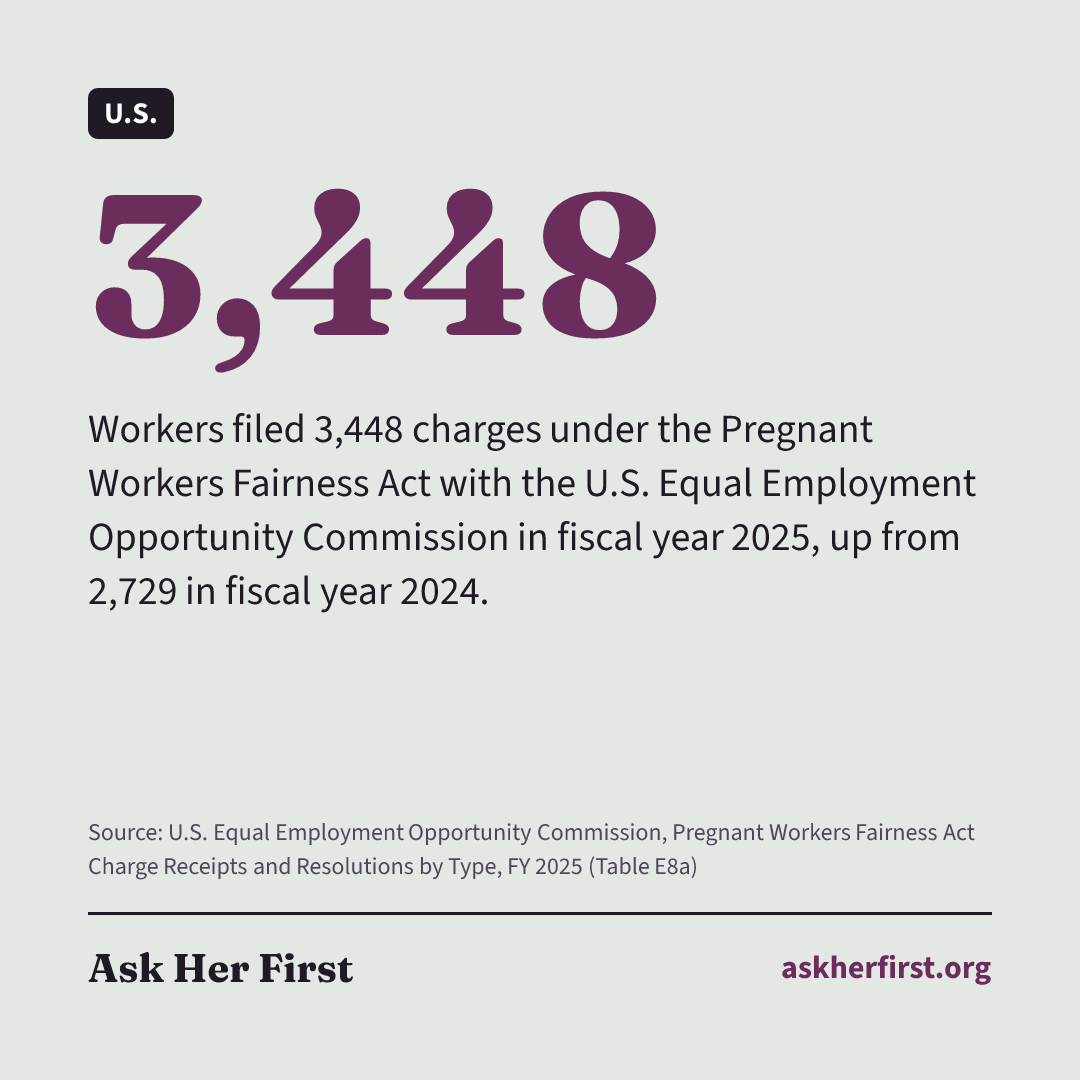
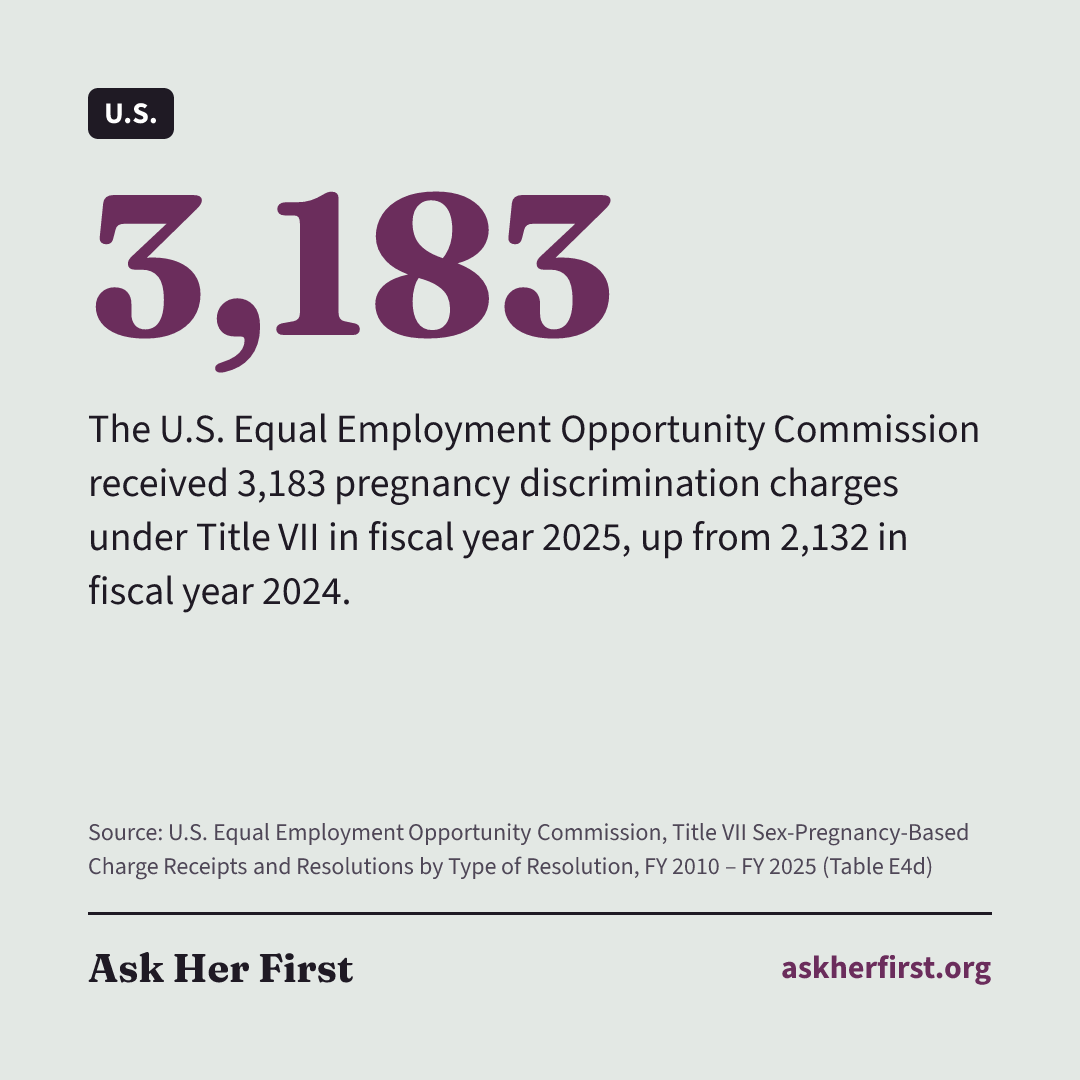
Many workers are using these protections to file complaints. Workers filed 3,448 charges under the Pregnant Workers Fairness Act with the U.S. Equal Employment Opportunity Commission in fiscal year 2025, up from 2,729 in fiscal year 2024.189 The U.S. Equal Employment Opportunity Commission received 3,183 pregnancy discrimination charges under Title VII in fiscal year 2025, up from 2,132 in fiscal year 2024.190 The U.S. Equal Employment Opportunity Commission secured $18.35 million for workers through Pregnant Workers Fairness Act charges in fiscal year 2025, not counting money obtained through lawsuits.189
These counts include only charges filed with the EEOC, not those filed with state or local agencies.189,190
State laws may protect you more
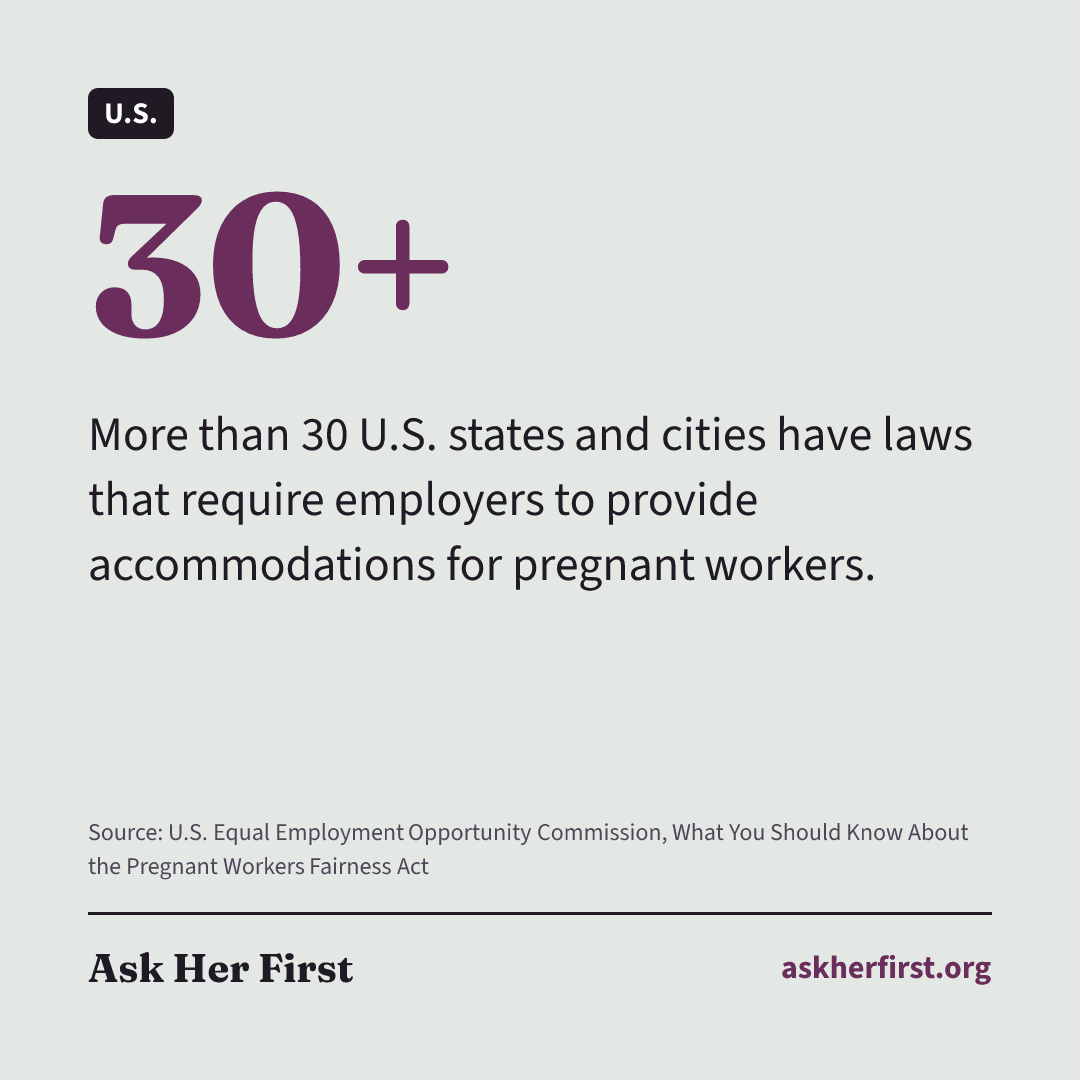
The EEOC says the PWFA does not replace federal, state, or local laws that are more protective of workers. More than 30 U.S. states and cities have laws that require employers to provide accommodations for pregnant workers.184 The EEOC also says some state laws provide additional protections, including unpaid and paid job-protected leave and additional lactation rights.185 The DOL says the federal pumping law does not override state or local laws that give employees greater protections.192
What we don’t know yet
The PWFA is new, and the EEOC’s PWFA charge table covers only fiscal years 2024 and 2025.189 A charge is a signed statement asserting that an employer discriminated, so charge counts show how many people filed, not how many experienced discrimination or were denied accommodations.187 The EEOC also notes that a charge filed under more than one law is counted under each, so the tables can’t simply be added together.189 We did not find a federal source that estimates how many workers need pregnancy accommodations or how many are turned down.
What you can do
- Ask for what you need. Tell your employer about your limitation and the change you need; the EEOC says a brief conversation or email is often enough.184
- Write down what happened and when. If you file a charge by letter, the EEOC asks for a short description of the actions you believe were discriminatory and when they took place.187
- Know your deadline. In general, you must file a charge with the EEOC within 180 calendar days of the discrimination, extended to 300 days if a state or local agency enforces a similar law.186 Using an internal complaint process generally does not pause that deadline.186 Federal employees generally must contact an agency EEO counselor within 45 days.186
- Contact the EEOC. Start with the EEOC Public Portal or call 1-800-669-4000.187 Deaf and hard of hearing callers can use TTY at 1-800-669-6820 or ASL video phone at 1-844-234-5122, and you can email [email protected].188 The EEOC does not take charges over the phone, but you can start the process that way.187 If your deadline is close, the EEOC says to call and ask for an immediate interview.187
- For pumping or FMLA problems, contact the DOL’s Wage and Hour Division, which enforces both laws, at 1-866-487-9243 (1-866-4US-WAGE).185,192
- Check your state’s laws, which may offer more protection than federal law.185
This article summarizes published research and official health information. It has not been reviewed by a clinician and is not medical advice. How we source.