If you are reading this because something in your relationship feels wrong, your instincts matter. The National Domestic Violence Hotline describes relationship abuse as a pattern of behaviors used to gain or maintain power and control over a partner, and says multiple types of abuse usually happen together.197 The Hotline says emotional abuse does not leave physical marks but still hurts, disempowers, and traumatizes the person experiencing it.199 The Hotline also says no one deserves to experience abuse of any kind, for any reason.198
If you are in immediate danger, call 911. If someone may be checking your phone or computer, the quick exit button at the top of this page takes you to a weather site, and our Browse safely page explains more.
What it is
The CDC defines intimate partner violence as abuse or aggression that happens in a romantic relationship, with either a current or former spouse or dating partner.195 It can range from one episode of violence to chronic and severe episodes over multiple years.195
The CDC describes four types:195
- Physical violence: hurting or trying to hurt a partner by using physical force.
- Sexual violence: forcing or attempting to force a partner to take part in a sex act, sexual touching, or a non-physical sexual event (such as sexting) when the partner does not or cannot consent.
- Stalking: a pattern of repeated, unwanted attention and contact that causes fear or concern for one’s own safety or the safety of someone close to the victim.
- Psychological aggression: using verbal and non-verbal communication with the intent to harm a partner mentally or emotionally, or to exert control over them.
Coercive control
In its national survey, the CDC counts “coercive control and entrapment” as part of psychological aggression: behaviors meant to monitor, control, or threaten a partner.196 The survey asked about tactics such as keeping a partner from having their own money, trying to keep them from family or friends, demanding to know where they are and what they are doing, threatening to hurt them, threatening self-harm or suicide because they were upset, making decisions that should have been the partner’s to make, and destroying something important to them.196
The Hotline uses the Power and Control Wheel, created by the Domestic Abuse Intervention Project in Duluth, Minnesota, to describe abuse.200 On the wheel, subtle and continual behaviors make up the inside, while physical and sexual violence form the outer ring and reinforce the subtler tactics.200
Other forms of abuse
The Hotline describes several forms of abuse that can overlap:197
- Emotional and verbal abuse: non-physical behaviors meant to control, isolate, or frighten someone. Examples include name-calling and constant criticism, extreme jealousy, isolating you from family and friends, monitoring where you go and who you talk to, humiliating you, threatening you, your children, or your pets, and blaming you for their abuse.
- Gaslighting: pretending not to understand or refusing to listen, questioning your memory of events, trivializing your needs or feelings, or denying previous statements or promises.
- Financial abuse: examples include giving you an allowance and closely monitoring how you spend it, depositing your paycheck into an account you can’t access, stopping you from working or getting you fired, maxing out your credit cards or harming your credit, and refusing to pay for necessities like food or medicine.
- Technology-facilitated (digital) abuse: using technology and online spaces to bully, harass, stalk, intimidate, or control a partner. Examples include demanding your passwords, looking through your phone, using spyware or GPS to monitor you, and using smart home devices or cameras to track your movements.
- Sexual abuse and sexual coercion: a partner controlling the physical and sexual intimacy in a relationship. Sexual coercion can range from begging and persuasion to forced sexual contact.
- Reproductive coercion: taking away a partner’s control over their own reproductive choices, such as tampering with birth control, forcing pregnancy, or forcing or preventing an abortion.
The Hotline says emotional abuse is serious, and that it is not uncommon for it to escalate to physical violence.199
Warning signs
The Hotline notes that many abusive people appear to be ideal partners early in a relationship, and that warning signs often emerge and intensify as the relationship grows.198 It lists these common signs of abusive behavior in a partner:198
- Telling you that you never do anything right
- Showing extreme jealousy of your friends or time spent away from them
- Preventing or discouraging you from spending time with friends, family, or peers
- Insulting, demeaning, or shaming you, especially in front of other people
- Preventing you from making your own decisions, including about working or attending school
- Controlling household finances without discussion, such as taking your money or refusing to provide money for necessary expenses
- Pressuring you to have sex or perform sexual acts you’re not comfortable with
- Pressuring you to use drugs or alcohol
- Intimidating you through threatening looks or actions
- Insulting your parenting or threatening to harm or take away your children or pets
- Intimidating you with weapons like guns, knives, bats, or mace
- Destroying your belongings or your home
The Hotline says even one or two of these behaviors is a red flag that abuse may be present.198 Its list of emotional abuse red flags also includes a partner who punishes you by withholding attention or affection, threatens suicide during arguments, or showers you with compliments and gifts and then uses that to manipulate you later, which it calls love bombing.199
What the research shows
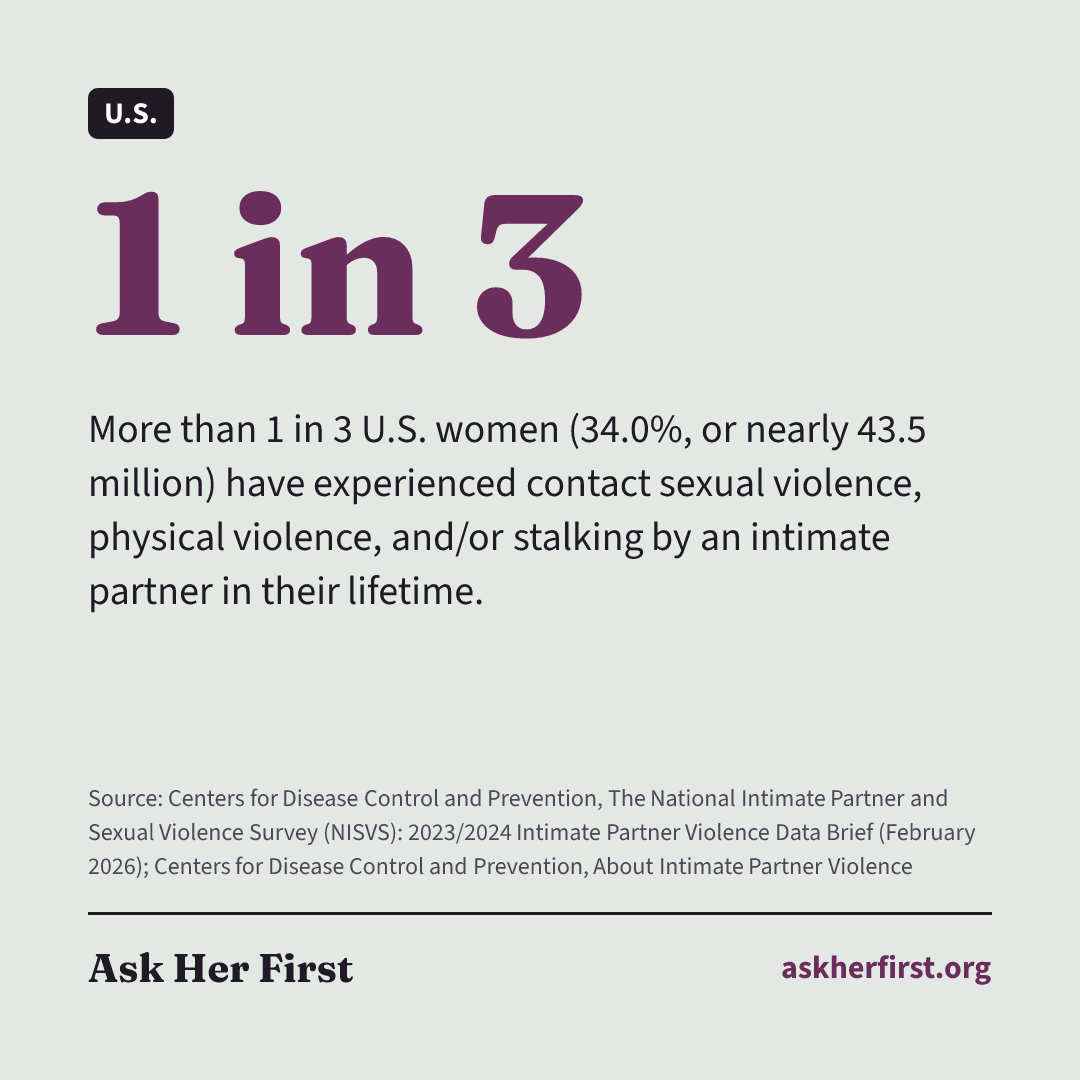
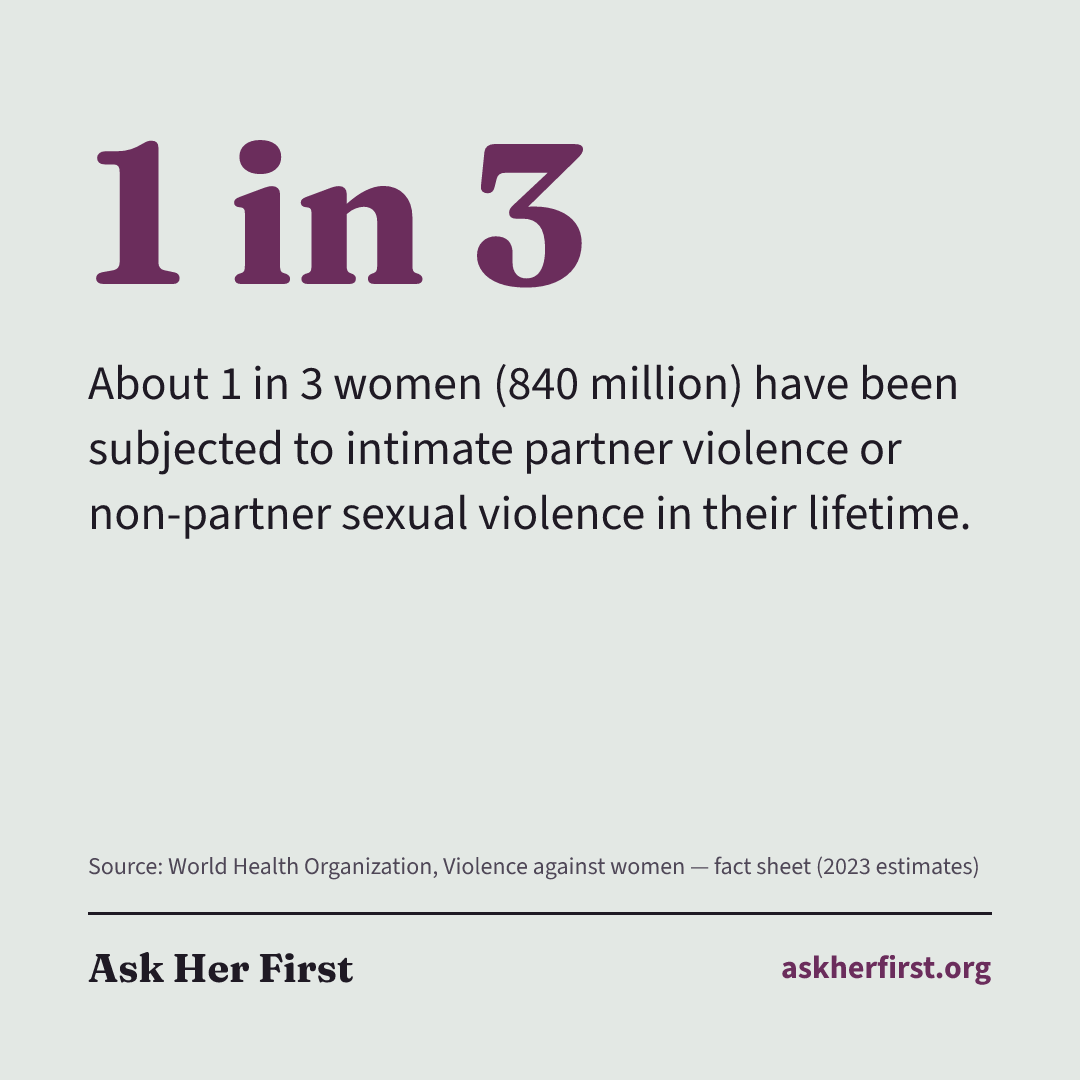
In the U.S., partner abuse is common. More than 1 in 3 U.S. women (34.0%, or nearly 43.5 million) have experienced contact sexual violence, physical violence, and/or stalking by an intimate partner in their lifetime.196,195 In the 12 months before the survey, 5.2% of U.S. women (about 6.7 million) experienced contact sexual violence, physical violence, and/or stalking by an intimate partner.196 The World Health Organization also tracks violence against women worldwide. About 1 in 3 women (840 million) have been subjected to intimate partner violence or non-partner sexual violence in their lifetime.3
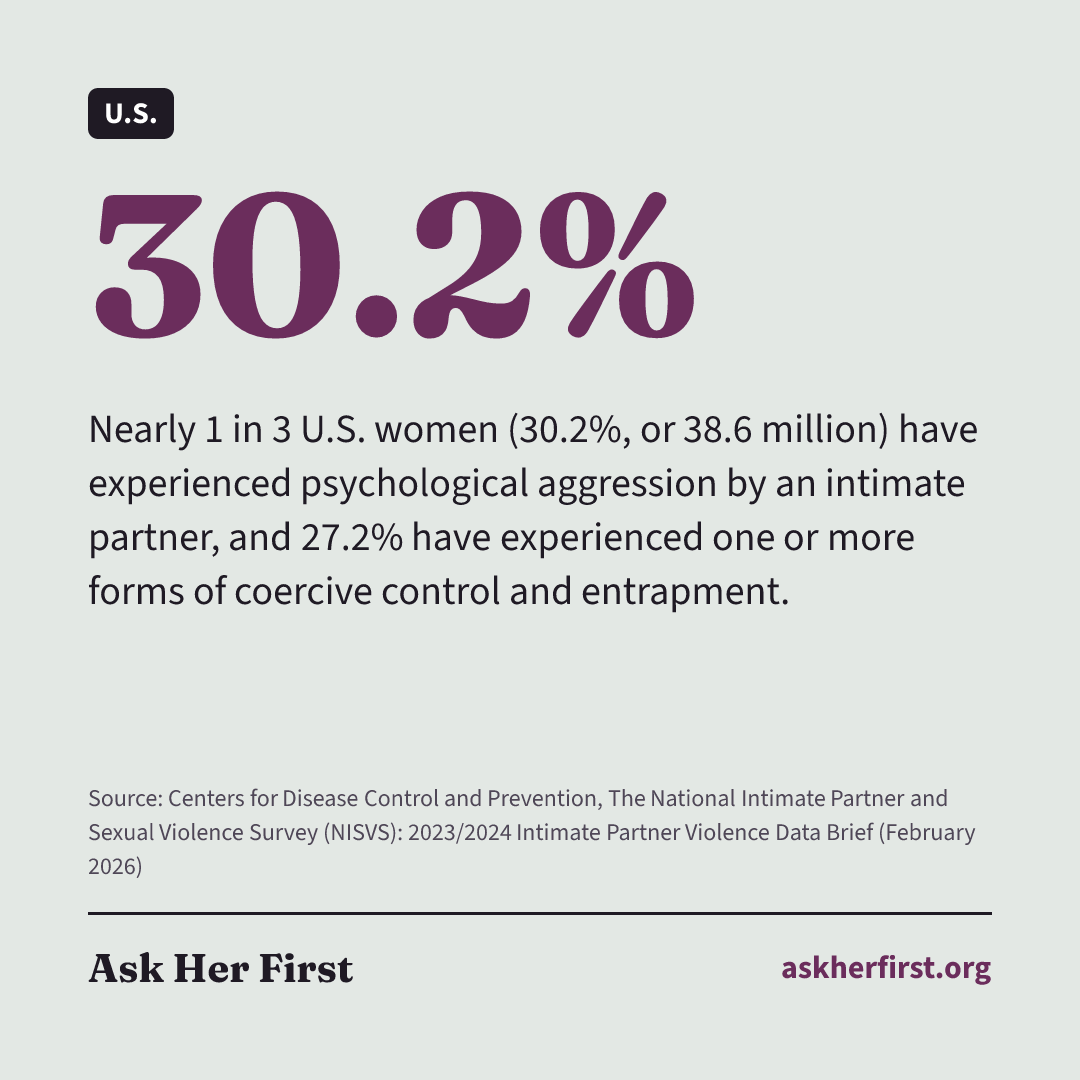
Control without physical violence is common too. Nearly 1 in 3 U.S. women (30.2%, or 38.6 million) have experienced psychological aggression by an intimate partner, and 27.2% have experienced one or more forms of coercive control and entrapment.196 In their lifetime, 18.6% of U.S. women have had an intimate partner keep track of them by demanding to know where they were and what they were doing, 16.0% had a partner try to keep them from seeing or talking to family or friends, and 8.8% had a partner keep them from having their own money.196 The CDC reports that keeping track of a partner and trying to keep them from family or friends were among the most common coercive tactics for both women and men.196
Physical violence and its effects are widespread. About 22.5% of U.S. women have experienced physical violence by an intimate partner in their lifetime, including 18.2% who experienced a severe form, such as being hit with a fist or something hard, kicked, slammed against something, or beaten.196 Nearly 1 in 3 U.S. women (29.9%) have experienced contact sexual violence, physical violence, and/or stalking by an intimate partner along with at least one related impact, such as being injured, missing work or school, being concerned for their safety, or needing medical care.196 The CDC says intimate partner violence starts early and continues throughout people’s lives.195 About 16 million U.S. women and 11 million men said they first experienced intimate partner violence before age 18.195
The CDC says intimate partner violence is associated with health conditions affecting the heart, muscles and bones, and the digestive, reproductive, and nervous systems, many of them chronic.195 Survivors can experience mental health problems such as depression and symptoms of post-traumatic stress disorder.195 The CDC says intimate partner violence can result in injuries and even death.195 Over half of female homicide victims in the U.S. are killed by a current or former male intimate partner, according to National Violent Death Reporting System data.195
Why leaving can be hard, and dangerous
Leaving is “not as easy as simply walking away,” in the Hotline’s words.201 The Hotline explains that when a survivor leaves, it threatens the power and control the abusive partner has established, which often causes that partner to retaliate in harmful ways.201 As a result, the Hotline says leaving is often the most dangerous period of time for survivors of abuse.201
The Hotline lists many other reasons people stay, including:201
- Fear of the partner’s actions, or of not being able to live independently
- Shame, including feeling that they did something wrong or deserve the abuse
- Intimidation through threats, including threats to share private information or images
- Lack of resources, such as being financially dependent on the abusive partner or having been kept from working
- Disability, when someone depends on others for physical support
- Children, and the wish to keep the family together, which an abusive partner may use to create guilt
- Love, because caring about a partner and experiencing abuse from them are not mutually exclusive
The Hotline says survivors deserve to be supported in their decisions and to reclaim control over their own lives.201
Planning for safety
The Hotline describes a safety plan as a personalized, practical plan to improve your safety while experiencing abuse, while preparing to leave, or after you leave.202 It notes that it can be hard to think clearly during a crisis, so having a plan laid out in advance can help.202 The Hotline offers an interactive safety plan tool and guidance on living with an abusive partner, children, pregnancy, pets, emotional safety, leaving, and legal protections.202 Its advocates are available 24/7 by phone or chat to help create a plan that fits your situation.203
Because every situation is different, we don’t give our own safety instructions here. Please use the Hotline’s guidance or talk with an advocate.
The Hotline also has guidance on documenting abuse, which it says can provide proof of a partner’s behavior if you ever need it, for legal reasons or otherwise.207 It advises storing documentation where your abuser is unable or unlikely to look.207
How to help a friend
If you are worried about someone, the Hotline says your instinct may be to “save them,” but abuse is never that simple.204 Survivors may not want to talk about the abuse for many reasons, including fear, shame, or concern for their partner.205 The Hotline says knowing how to have conversations that empower survivors to make their own decisions is one of the most important ways to help.205
The Hotline suggests these ways to offer emotional support:204
- Acknowledge that their situation is difficult and scary.
- Don’t judge their decisions or guilt them over a choice they make.
- Remember that you can’t “rescue” them; decisions about their life are theirs to make.
- Don’t speak poorly of the abusive partner.
- Help them create a safety plan.
- Keep supporting them if they end the relationship, feel lonely or upset, or return to their partner.
- Offer to go with them to a service provider or legal setting for moral support.
It also suggests practical help, such as storing important documents or a “to-go bag,” helping document abuse if they give permission, not posting information on social media that could identify them or where they spend time, and encouraging them to contact the Hotline or its teen and young adult project, love is respect.204
What we don’t know yet
The newest U.S. figures come from a CDC survey collected from September 2023 through September 2024, and the CDC says its response rate was lower than anticipated.196 The CDC notes that the survey did not include people living in institutions or people who are unhoused, which may mean it underestimates how common partner violence is.196 Because the survey methods changed, the CDC cautions against comparing these results with earlier years.196 Some figures cited on CDC pages, such as the homicide and first-experience data above, come from older data years.195
What you can do
- Trust what you’re noticing. Compare what’s happening with the Hotline’s warning signs and types of abuse.
- Talk with an advocate. The Hotline says its services are free, confidential, and available 24/7, and that advocates will never make decisions for you.206 It advises contacting it when your partner isn’t around.206
- Make a safety plan with the Hotline’s safety planning tools or with an advocate.
- Protect your privacy online. See the Hotline’s internet safety guidance and our Browse safely page.
- If you’re worried about a friend, listen without judgment and let them lead. Share the Hotline’s ways to support.
- In an emergency, call 911.
This article summarizes published research and official health information. It has not been reviewed by a clinician and is not medical advice. How we source.