If you have been sexually assaulted, the Office on Women’s Health (OWH) says it is not your fault, regardless of the circumstances.260 The VA’s National Center for PTSD says sexual assault is never the fault of the person who is assaulted, and that no one wants or deserves it.261 Many of the next steps are your choice: a U.S. Department of Justice protocol for sexual assault exams says that, except where the law requires a report, deciding whether to report to police is the patient’s decision, and that patients can decline any part of the exam.257 This page walks through your options so you can decide what is right for you, at your own pace.
If you are in immediate danger, call 911.259 OWH says that if you can, get away from the person who assaulted you and get to a safe place.260 If someone may be checking your phone or computer, the quick exit button at the top of this page takes you to a weather site, and our Browse safely page explains more.
Support
You don’t have to go through this alone. The Justice Department’s Office for Victims of Crime (OVC) says local sexual assault programs have trained advocates who provide free and confidential services, including going with survivors to the hospital for a forensic exam, and that rape crisis centers can help whether or not you report the crime.275
RAINN’s National Sexual Assault Hotline connects callers with a trained staff member from a sexual assault service provider in their area.265 You can call 800-656-HOPE (4673), text HOPE to 64673, or chat at hotline.rainn.org/online.272,259 OWH says the calls are free and confidential and you can call any time, day or night, but notes they may appear on your phone bill; if the person who assaulted you might check it, OWH suggests using a friend’s phone or a public phone.260 OWH also lists the Department of Defense Safe Helpline for military members at 877-995-5247, and OVC lists the StrongHearts Native Helpline for Native Americans at 844-762-8483.260,272
Getting medical care
Getting care soon can matter even if you don’t see injuries: the Justice Department protocol notes that HIV prevention and pregnancy prevention are time sensitive, that some injuries heal quickly, and that evidence on the body can be lost as time passes.257 OWH suggests calling 911 or going to the nearest hospital emergency room to be examined and treated for injuries, and says the doctor or nurse may give you medicine to prevent HIV and some other sexually transmitted infections (STIs) and emergency contraception to prevent pregnancy.260
The protocol says sexual assault patients should be given priority as emergency cases.257 It also says patients have the right to care for assault-related injuries and concerns whether or not they report or agree to evidence collection, and that they can be treated, including for STIs, without having the forensic exam.257
The sexual assault forensic exam
What it involves
The Justice Department’s Office on Violence Against Women (OVW) describes a sexual assault medical forensic examination (SAFE) as an exam by a clinician, ideally one with specialized training, that includes a medical history, a comprehensive exam, coordinating treatment of injuries, documentation, and collecting samples for an evidence kit, along with information, treatment, and referrals for STIs, pregnancy prevention, and other health concerns.258 OVW says advocates may be present to support the patient through the process.258 OWH suggests asking for a sexual assault forensic examiner (SAFE) or a sexual assault nurse examiner (SANE), and says the National Sexual Assault Hotline can help you find a hospital with staff trained to collect evidence.260
OVW’s national protocol for these exams is a guideline for suggested practices rather than a list of requirements, and it leaves many details to local policy.257 It describes the exam as having two purposes: caring for your health and, if you agree, collecting samples from your body and clothing for an evidence kit.257 Because clothing may be kept as evidence, the protocol notes you may want to bring, or have someone bring, a clean change of clothes.257 With your consent, the exam may also include photographs and, if you think you may have been drugged, toxicology testing.257
According to the protocol, each part of the exam should be explained before it happens, and you can ask questions, take breaks, and decline any part at any time, even after agreeing to it.257 The exam should be tailored to what happened, so you shouldn’t be put through steps you don’t need.257 The protocol also recommends accommodating requests to have a friend, relative, or other support person with you unless that person may be harmful, and requests for responders of a specific gender as much as possible.257
Timing
The protocol says samples should be collected as soon as possible and up to 5 days or longer after an assault, because DNA evidence breaks down over time; if drugging is suspected, it says urine samples should be collected within 120 hours and blood samples within 24 hours.257 It stresses that these time frames are only benchmarks and should not be used to deny care to anyone who has been sexually assaulted.257
If you have already showered, changed clothes, or cleaned up, you can still have an exam. The protocol says it is common for survivors to have showered, eaten, or washed clothes or bedding before seeking help, and that advocacy and an exam should still be offered because these services don’t depend on finding DNA evidence.257 If you are able to, OWH suggests not washing or changing clothes, and the protocol mentions holding off on urinating, eating, or drinking, to help preserve evidence; the protocol adds that no one should be retraumatized or made ill for the sake of evidence.260,257 If you think you were drugged, OWH suggests asking hospital staff about testing for date rape drugs, and notes that these drugs pass through the body quickly and may not be detectable by the time you are tested.260
You don’t have to report to get an exam
OWH says you do not need to press charges to have evidence collected, and you don’t have to decide about pressing charges while you are at the hospital.260 The protocol says that even if you aren’t ready to report, having the exam done and evidence collected is the best way to keep all your options open, and it encourages patients to have the exam as soon as possible and then take time to decide about reporting.257 It also notes that many jurisdictions don’t keep kits indefinitely when no police report is made, and says patients should be told the local policies on keeping and destroying kits.257
Paying for the exam
Under the Violence Against Women Act (VAWA), states and other governments that receive STOP grant funds must cover the full out-of-pocket cost of forensic medical exams for sexual assault victims, whether or not the victim takes part in the criminal justice system or cooperates with law enforcement.277,257 The protocol explains that this includes charges such as an exam fee, or a copayment or deductible where charges are billed to insurance.257 Related medical care, such as treatment for injuries or STIs, often isn’t covered by this requirement, and some jurisdictions ask patients to apply separately for crime victim compensation.257 OVC says compensation benefits can include reimbursement for medical services, mental health counseling, lost wages, and other costs caused by the crime, though eligibility rules vary by state.274,275
Preventing pregnancy
If pregnancy is possible, emergency contraception can reduce the chance of becoming pregnant.268 The protocol calls emergency contraception the standard of care after sexual assault, says it should be provided to any patient who wants it, and notes that most programs offer it to patients seen within 120 hours of the assault.257 The FDA’s birth control guide lists two emergency contraceptive pills:267
- Levonorgestrel 1.5 mg (such as Plan B One-Step): the FDA recommends taking it as soon as possible within 72 hours after unprotected sex, and it is available without a prescription.266
- Ulipristal acetate (ella): taken as soon as possible within 120 hours (5 days), and available by prescription.268
The FDA says the most important factor in how well emergency contraception works is how quickly it is taken.266 Neither pill will end a pregnancy that is already in progress.257,266 The protocol says a copper IUD placed within 5 days is another option in some places.257 Emergency contraception does not protect against HIV or other STIs.268,257
Preventing HIV and other infections
Medicine called PEP (post-exposure prophylaxis) can prevent HIV after a possible exposure; the CDC says it must be started within 72 hours (3 days), lists sexual assault among the reasons to talk with a health care provider about it right away, and says the sooner you start, the better.269 CDC guidelines updated in 2025 say the first dose should be given as soon as possible, ideally within 24 hours, and that a course lasts 28 days.270 The CDC’s STI treatment guidelines say people have acquired HIV through sexual assault but that this likely happens infrequently, and that recommendations for PEP after an assault are made case by case, based on risk.271 After a sexual assault, you may qualify for partial or total reimbursement for PEP medicines and clinical care costs, according to the CDC.269
For other STIs, the CDC says trichomoniasis, bacterial vaginosis, gonorrhea, and chlamydia are the most frequently diagnosed infections among women who have been sexually assaulted, and that finding one after an assault does not necessarily mean it came from the assault.271 Because follow-up visits are often missed, the CDC recommends routine preventive treatment after an assault for chlamydia, gonorrhea, and trichomoniasis in women, plus hepatitis B vaccination and, through age 26, HPV vaccination for survivors who aren’t already vaccinated, with follow-up testing in some cases.271 If you are worried that test results could be used against you, the CDC notes that laws in all 50 states limit the use of a survivor’s past sexual history, including previous STIs, as evidence.271
Your feelings and mental health
There is no one right way to react: the Justice Department protocol notes that trauma can show up in many ways, including laughing or joking, hostility, or seeming flat, and says clinicians should not judge a patient’s credibility based on these reactions.257 OWH says you may feel fear, shame, guilt, or shock, and that all of these feelings are normal.260
The VA’s National Center for PTSD says some survivors are affected only in the short term and recover on their own, while others have longer-lasting mental or physical health problems, and that help is available either way.261 In one large study cited by the VA's National Center for PTSD, almost half of women who had been sexually assaulted went on to develop PTSD.261 The VA says depression is also a common reaction, and that survivors are at higher risk of thinking about, attempting, or dying by suicide.261 The National Institute of Mental Health (NIMH) says PTSD symptoms usually begin within 3 months of a traumatic event but sometimes appear later, that most people recover from their symptoms after trauma over time, and that the main treatments for PTSD are psychotherapy, medication, or both.262
If you have symptoms that trouble you, the VA suggests talking with a health care provider or mental health professional, and says a local rape crisis center or victim services agency should be able to refer you.261 If you are struggling or having thoughts of suicide, NIMH says to call or text the 988 Suicide & Crisis Lifeline at 988.263
Reporting is your choice
Except where the law requires a report, the protocol says deciding whether to report a sexual assault to police is the patient’s decision.257 In some places, health workers must report some or all sexual assaults, and rules may differ for minors and vulnerable adults; the protocol says staff should tell you as soon as possible if they are required to report, and that even then, you are not obligated to talk with police.257
You can take time to decide, though the protocol notes that long delays can mean lost evidence and can make a case harder to investigate and prosecute.257 OWH says that to report an assault that happened in the past, you can call your local police non-emergency number or make a report in person at a police station.260 Many law enforcement agencies also allow alternatives, such as reporting without identifying yourself, sometimes called “Jane Doe” or “blind” reporting.257 OWH says staff at a rape crisis center can help you make choices about reporting, and an advocate or counselor at the National Sexual Assault Hotline can help you understand how to report.260
Your rights
OVC says every U.S. state, the federal government, and many Tribal jurisdictions have basic legal rights and protections for victims of crime.273 In federal criminal cases, the Survivors’ Bill of Rights Act of 2016 gives sexual assault survivors added rights, including the right not to be prevented from, or charged for, a medical forensic exam, and the right to have an evidence kit preserved without charge for the maximum applicable statute of limitations or 20 years, whichever is shorter.276,278 For a referral to local victim services, OVC points to the VictimConnect helpline, which you can call or text at 855-484-2846.273
What the numbers show
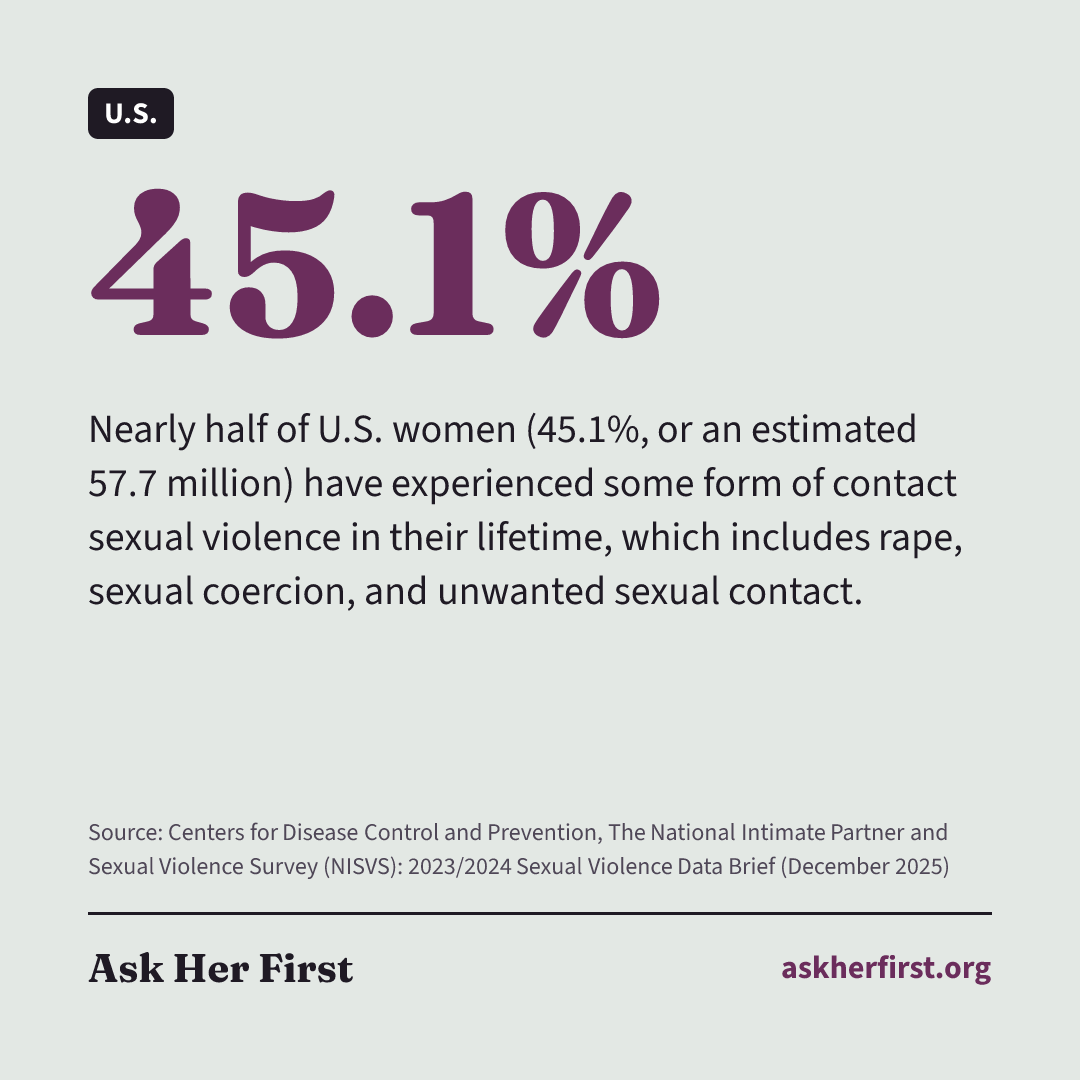
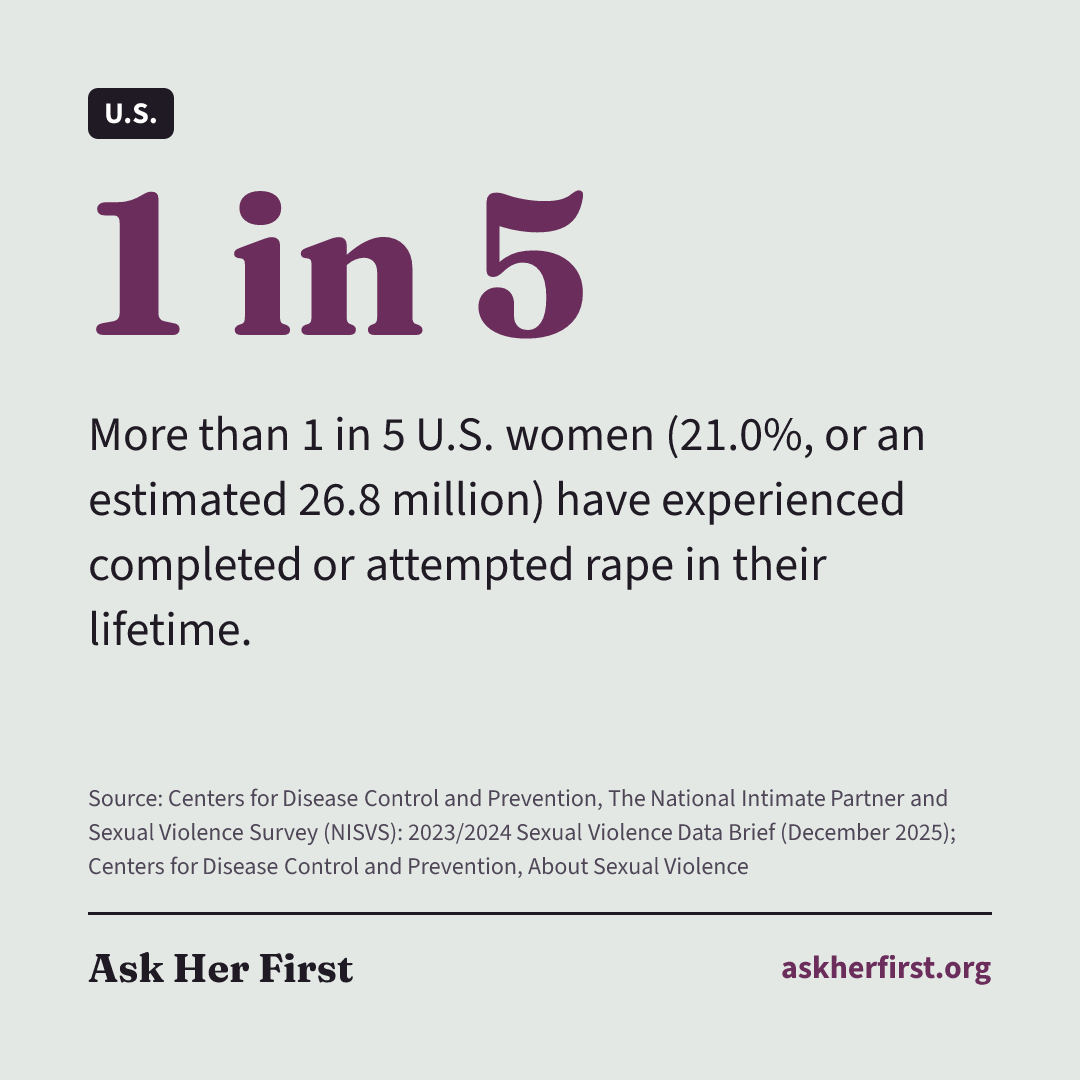
Sexual violence is common, and you are not alone.264,260 Nearly half of U.S. women (45.1%, or an estimated 57.7 million) have experienced some form of contact sexual violence in their lifetime, which includes rape, sexual coercion, and unwanted sexual contact.264 More than 1 in 5 U.S. women (21.0%, or an estimated 26.8 million) have experienced completed or attempted rape in their lifetime.264,265 In the 12 months before the survey, 1 in 18 U.S. women (5.5%, or an estimated 7.0 million) experienced some form of contact sexual violence.264 An estimated 8.2% of U.S. women (about 10.5 million) have experienced completed alcohol- or drug-facilitated rape, meaning they were raped while too drunk, high, drugged, or passed out to consent or to stop it.264 Sexual violence affects men, too.265 More than 1 in 6 U.S. men (16.9%) have experienced some form of contact sexual violence in their lifetime.264
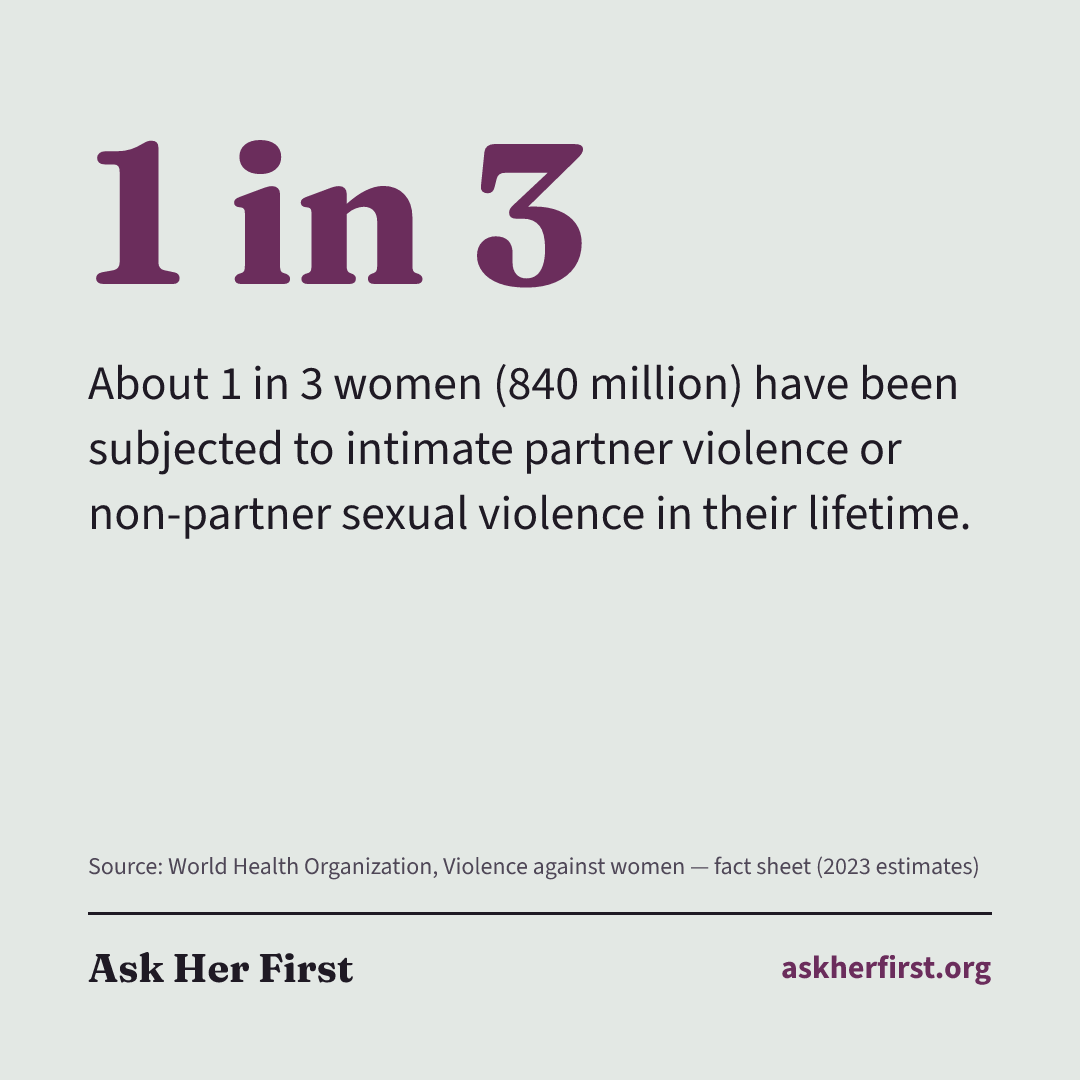
The CDC says the perpetrator is usually someone the survivor knows, such as a friend, a current or former intimate partner, a coworker, a neighbor, or a family member.265 More than 4 in 5 U.S. female rape survivors reported that they were first raped before age 25, and almost half were first raped before age 18.265 Globally, an estimated 8% of women older than 15 (263 million) have been subjected to sexual violence by someone other than a partner at least once since age 15.3 WHO says the actual prevalence is likely much higher because violence against women is particularly stigmatized.3
The CDC says the numbers underestimate the problem because many cases are unreported: survivors may be ashamed, embarrassed, or afraid, may have been threatened, or may not think anyone will believe or help them.265 The VA says false reports of sexual assault are rare, and that assault is more likely to go underreported.261
What we don’t know yet
- How complete the survey numbers are. The CDC’s 2023/2024 survey did not include people living in institutions or experiencing homelessness, which may mean it underestimates sexual violence, and the CDC cautions against comparing it with earlier years because its methods changed.264 The age-at-first-rape figures come from the CDC’s older 2016/2017 survey.265
- How well preventive treatments work after an assault. The CDC says the effectiveness of its recommended antibiotic regimens in preventing infections after sexual assault has not been evaluated.271 The Justice Department protocol says a definitive statement of benefit can’t be made about PEP after sexual assault, though the possibility of HIV exposure should still be assessed and discussed.257
- Emergency contraception and body weight. The protocol notes some concern that levonorgestrel pills may work less well for people with a higher body mass index (BMI), but says the research is not conclusive and the FDA has not recommended a change to the packaging.257
What you can do
- If you are in immediate danger, call 911.259
- You don’t have to decide everything at once. You can get medical care and an exam first, then take time to decide about reporting.257,260
- Reach out for support. The National Sexual Assault Hotline, 800-656-HOPE (4673), can connect you with local help, and OVC suggests asking your local rape crisis center for an advocate to go with you to your exam.265,275
- Keep timing in mind if you are worried about pregnancy or HIV. Emergency contraception and PEP work best the sooner they are started.266,269
- If someone tells you they were assaulted, OWH suggests listening, reminding them that you believe them and that it was not their fault, and asking whether they would like you to go with them to the hospital, to counseling, or to the police.260
This article summarizes published research and official health information. It has not been reviewed by a clinician and is not medical advice. How we source.