If you are struggling or having thoughts of suicide, you can call or text the 988 Suicide & Crisis Lifeline at 988 or chat at 988lifeline.org, and in a life-threatening situation, call 911.5 Veterans, and people worried about a veteran, can call 988 and press 1 to reach a responder trained to help veterans.6
If something frightening happened to you and you don’t feel like yourself, you are not weak and you are not alone. The VA’s National Center for PTSD says it is common to have an emotional reaction after a traumatic event, that these stress reactions are normal and not weakness, and that most people recover in time.6 This page explains common reactions, what post-traumatic stress disorder (PTSD) is, why women develop it more often, and how it’s treated.
Reactions after trauma are common
The National Institute of Mental Health (NIMH) says common reactions after a traumatic event, such as a natural disaster, an act of violence, or a serious accident, include feeling anxious, sad, or angry, having trouble concentrating and sleeping, and thinking about what happened.5 The VA lists other common reactions, including feeling jumpy and startling easily, having upsetting dreams and memories, avoiding reminders of the event, feeling numb or detached, being irritable, and blaming yourself.6
Going through trauma does not mean you will develop PTSD. NIMH says most people will recover from these symptoms and their reactions will lessen over time.5 About half of all U.S. adults will experience at least one traumatic event in their lives, but most do not develop PTSD, according to NIMH.7 The Office on Women’s Health (OWH) says that for most people, feelings of fear and anxiety after a dangerous event fade within a few weeks, and that most women who go through trauma won’t get PTSD.8
The VA says recovery is a gradual process, and that turning to family and friends when you are ready to talk can help.6 It suggests talking to a counselor or doctor if your stress reactions are getting in the way of your relationships, work, or other important activities.6
What PTSD is
NIMH says people may be diagnosed with PTSD if their symptoms last for an extended period after a traumatic event and begin to interfere with daily life, such as relationships or work.5 PTSD can follow many kinds of events: NIMH names combat and physical or sexual assault, abuse, accidents, disasters, and terror attacks, and says that learning a relative or close friend went through trauma can sometimes cause PTSD.9 Anyone can develop PTSD at any age.9
The four groups of symptoms
NIMH says that to be diagnosed with PTSD, an adult must have all of the following for at least 1 month, severe enough to interfere with daily life such as relationships or work:9
- Re-experiencing (at least one). Flashbacks, which can include physical symptoms like a racing heart or sweating; recurring memories or dreams about the event; distressing thoughts; and physical signs of stress.9
- Avoidance (at least one). Staying away from places, events, or objects that are reminders, or avoiding thoughts or feelings related to the event.9
- Arousal and reactivity (at least two). Being easily startled, feeling tense or on edge, trouble concentrating or sleeping, irritability or angry outbursts, and risky or destructive behavior.9
- Cognition and mood (at least two). Trouble remembering key parts of the event, negative thoughts about yourself or the world, exaggerated blame of yourself or others, ongoing fear, anger, guilt, or shame, losing interest in activities, feeling isolated, and difficulty feeling positive emotions.9
Having some of these symptoms is not the same as having PTSD. OWH says you could have another mental health condition, or you could be having a natural response in the weeks after the event.8 The VA says only a mental health provider can diagnose PTSD, and it offers a short self-screen of 5 questions as a starting point.10 The self-checks on this site screen for depression and anxiety; none of them is a PTSD screen.
When symptoms start
NIMH says PTSD symptoms usually begin within 3 months of the traumatic event, but they sometimes emerge later.9 The VA adds that symptoms may not appear until months or years later, and may come and go over many years.10 The course varies: some people recover within 6 months, while others have symptoms that last a year or longer.9
How common PTSD is in women
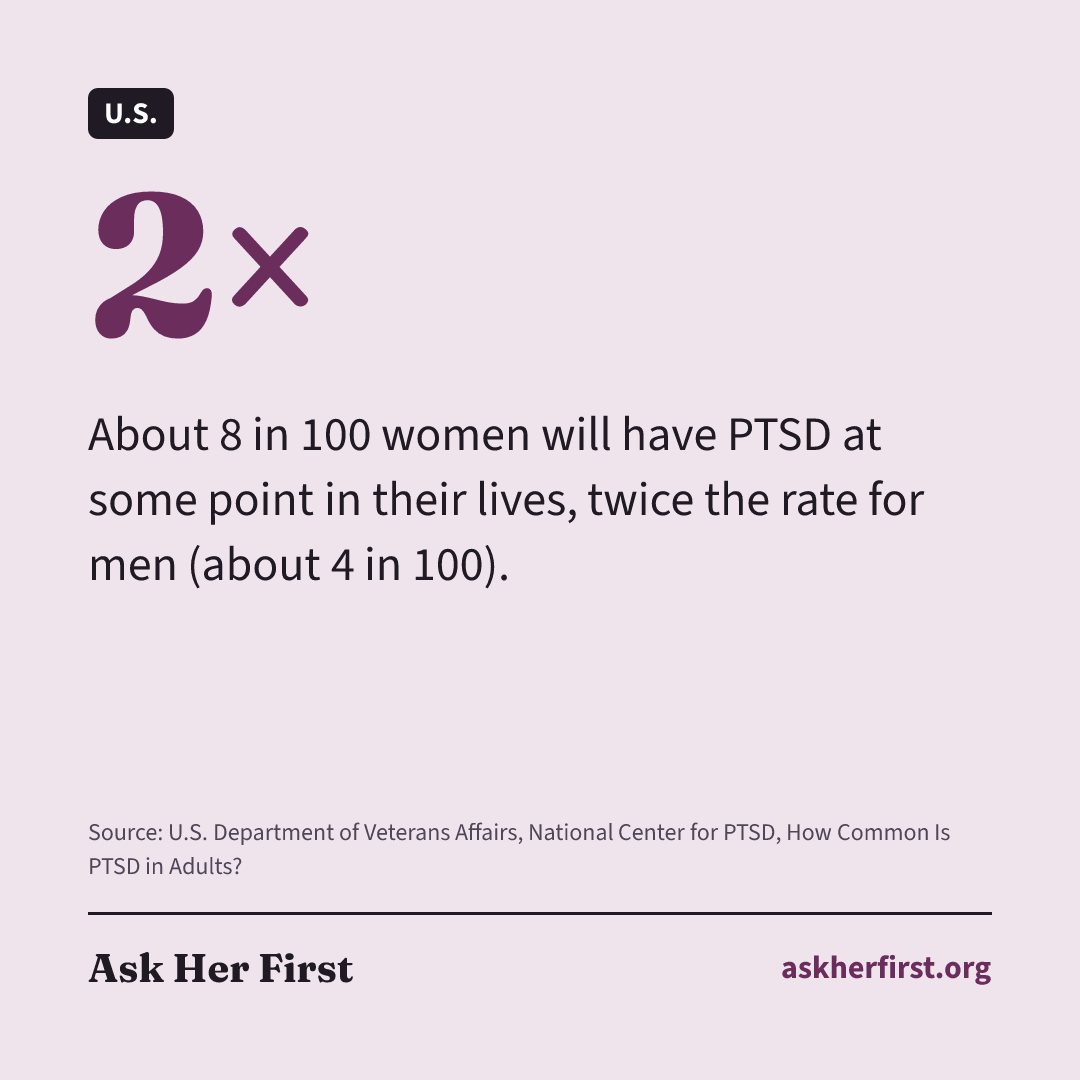
U.S.About 8 in 100 women will have PTSD at some point in their lives, twice the rate for men (about 4 in 100).11 The VA says this is in part due to the types of traumatic events women are more likely to experience, such as sexual assault.11 NIMH’s national survey data show the same pattern for PTSD in the past year. In a national survey done in 2001–2003, 5.2% of U.S. women had PTSD in the past year, compared with 1.8% of men.7
These numbers are estimates. The VA says we don’t know the exact number of people who have PTSD, partly because many people have never talked to a doctor about their trauma or symptoms, and because more people may be at risk during wars, pandemics, or years with many disasters.11
Why women may be affected differently
The kinds of trauma differ. The VA says it is more common for women to be sexually assaulted, while men are more likely to experience accidents, physical assault, or combat, or to witness death or injury.11 OWH says women with PTSD are more likely than men with PTSD to have been physically or sexually attacked.8
Other factors can raise anyone’s risk. OWH says you may be more likely to develop PTSD if you were directly exposed to the trauma, were seriously hurt, went through trauma that was very severe or lasted a long time, have another mental health condition like depression or anxiety, don’t have a good support network, or experienced trauma in childhood.8 NIMH says support from friends, family, or support groups is among the factors that may reduce the likelihood of PTSD.9
Symptoms may look different, too. OWH says women with PTSD may be more likely than men with PTSD to be easily startled, have more trouble feeling emotions or feel numb, avoid reminders of the trauma, and feel depressed and anxious.8 The Office on Women's Health says women usually have PTSD symptoms longer than men before diagnosis and treatment: on average, 4 years versus 1 year.8
After sexual assault
The VA’s National Center for PTSD says some people feel affected by sexual assault only in the short term and recover on their own, while others have longer-lasting mental or physical health problems, and that help is available either way.12 It describes guilt, shame, fear, confusion, anger, and trouble trusting others as common and understandable reactions after sexual assault.12
The VA says one large study suggests sexual assault is the traumatic event most likely to result in PTSD.12 In one large study cited by the VA's National Center for PTSD, almost half of women who had been sexually assaulted went on to develop PTSD.12 The VA also says survivors are at higher risk of thinking about, attempting, or dying by suicide, and that some survivors use alcohol or drugs to try to numb their feelings or escape memories of the assault.12
If an assault happened recently, our guide What to do after a sexual assault covers medical care, the forensic exam, and your options. Read more about feelings in the weeks after: Your feelings and mental health.
Abuse, stalking, and ongoing trauma
Trauma isn’t always a single event. NIMH says some people with PTSD, such as those in abusive relationships, may be living through ongoing trauma, and that treatment is usually most effective when it addresses both the traumatic situation and the PTSD symptoms.9 If you are not sure whether what is happening at home is abuse, Signs of an abusive relationship can help. If someone is following, watching, or tracking you, see Stalking and tech abuse.
Military sexual trauma and veterans
The VA uses the term military sexual trauma (MST) for sexual assault or sexual harassment a veteran experienced during military service.13 The VA says many people recover from MST without professional help, but PTSD is one of the most common mental health diagnoses among MST survivors.13 It says care for physical and mental health conditions related to MST is free, that veterans don’t need a VA disability rating or to have reported the incident at the time, and that they may be able to get this care even if they aren’t eligible for other VA care.13 Every VA health care facility has a designated MST Coordinator who can help veterans find and access VA services, and veterans can ask to meet with a clinician of a particular sex if that would feel more comfortable.13
Conditions that often come with PTSD
NIMH says people with PTSD often have co-occurring conditions, such as depression, substance use, or one or more anxiety disorders.9
- Depression. The VA says depression often occurs after trauma, that many of its symptoms overlap with PTSD, and that it’s possible to have both at the same time.14 It says some types of therapy and medicine help with both.14
- Alcohol and drugs. The VA says problems with alcohol or drugs often go hand in hand with PTSD, that using them can make PTSD symptoms worse, and that PTSD and substance use can be treated successfully at the same time.15 OWH says women with PTSD are less likely than men with PTSD to have problems with alcohol or drugs after the trauma.8
- Suicidal thoughts. OWH says many people with PTSD have other mental health conditions, including suicidal thoughts or behaviors, and that treatment works best when these are treated at the same time.8
Treatment for PTSD
PTSD is treatable. The VA says PTSD treatment works, that there are several options, and that no single treatment is right for everyone.16 NIMH says the main treatments are psychotherapy, medications, or both, and that it is important to work with a mental health professional who has experience treating PTSD.9 The VA says that for many people, treatment can get rid of symptoms altogether, while others have fewer or less intense symptoms.10
Talk therapies that focus on the trauma
The VA says the talk therapies with the most research support are trauma-focused, meaning they focus on the traumatic event and what it means to you.16 It names three:10
- Cognitive processing therapy (CPT), where you learn skills to understand how trauma changed your thoughts and feelings.10
- Prolonged exposure (PE), where you gradually approach trauma-related memories, feelings, and situations you have been avoiding.10
- Eye movement desensitization and reprocessing (EMDR), where you process the memory of the trauma while paying attention to a back-and-forth movement or sound.10
The VA says these therapies usually last about 8 to 16 sessions.16 NIMH describes psychotherapy for PTSD more generally as usually lasting 6 to 12 weeks, though it can last longer, and says it can take place one on one or in a group.9
Medications
NIMH says the Food and Drug Administration (FDA) has approved two selective serotonin reuptake inhibitors (SSRIs), a type of antidepressant, to treat PTSD.9 The VA says the medications with the most evidence are sertraline, paroxetine, and venlafaxine.10,16 It says it can take a few weeks to notice a change, that the benefits end after the medication is stopped, and that possible side effects include upset stomach, sweating, headache, dizziness, and sexual side effects.16,17 NIMH says some medications may help with specific symptoms such as sleep problems and nightmares.9
Decisions about medication are best made with a prescriber who knows your health history.
Where guidelines differ
Expert groups broadly agree on trauma-focused therapy but rank some treatments differently:
- 2023 VA and Department of Defense guideline. It recommends specific manualized psychotherapies over medication; recommends prolonged exposure, cognitive processing therapy, or EMDR; recommends paroxetine, sertraline, or venlafaxine; and recommends against benzodiazepines, cannabis, or cannabis-derived products.18
- American Psychological Association guideline (summary published 2019). It strongly recommends cognitive-behavioral therapy, cognitive processing therapy, cognitive therapy, and prolonged exposure, and gives a weaker, conditional recommendation to EMDR, brief eclectic psychotherapy, and narrative exposure therapy.19 It conditionally recommends fluoxetine, paroxetine, sertraline, and venlafaxine.19 The panel said newer studies could move EMDR and narrative exposure therapy from conditional to strong.19
One clear difference is EMDR: the newer VA and Defense guideline recommends it alongside CPT and PE, while the APA guideline’s recommendation for it is conditional.18,19
Finding care after trauma
If you were sexually assaulted, the VA says a local rape crisis center or victim services agency should be able to refer you to a mental health provider who can help.12 Veterans who experienced MST can speak with their VA health care provider or contact the MST Coordinator at their nearest VA medical center.13
When choosing a treatment, the VA suggests asking which options are available to you, whether you feel you can work well with the therapist, and which treatments fit your goals and preferences.20 It says that even among the most strongly recommended treatments, how well a treatment works varies from person to person, and there is no scientific way yet to know which will work best for you.20 The VA’s free online PTSD Treatment Decision Aid lets you compare treatments and make a summary of your goals to share with your provider.20
For practical steps like finding a therapist, low-cost care, and what to expect at a first appointment, see Finding mental health care.
Helping someone with PTSD
NIMH says the most important thing you can do is help the person get the right diagnosis and treatment, which might mean helping them make an appointment or going with them to visits.9 It also suggests offering emotional support, patience, and encouragement, learning about PTSD, listening carefully, and sharing positive distractions such as walks and outings.9 If you are worried someone may be thinking about suicide, the VA says to ask them, and that asking will not put the idea in their head.6 Our Help someone else page has more on what to say.
What we don’t know yet
- Exact numbers. The VA says there is no exact or up-to-date count of people with PTSD.11 NIMH’s figures on PTSD in the past year come from a survey done in 2001–2003 that used older diagnostic criteria.7 Estimates of how many people go through trauma also vary by source. The Office on Women's Health says at least 4 in 5 people experience some type of trauma in their lifetimes.8
- Who is missing from the research. The VA says more research is needed to understand how trauma risk varies by race and ethnicity, religion, sexuality, disability status, and other social factors.11
- Who will recover without treatment. NIMH says researchers are still studying how to identify which trauma survivors are likely to recover naturally and which may benefit from treatment.5
- Which treatment will work for you. The VA says there is no scientific way yet to predict which PTSD treatment will work best for an individual.20
Questions to ask your doctor
- Could what I’m feeling be a normal reaction after trauma, PTSD, or something else, such as depression or anxiety?
- Do you have experience treating PTSD? If not, can you refer me to someone who does?
- Which trauma-focused therapies do you or your practice offer: cognitive processing therapy, prolonged exposure, or EMDR?
- How many sessions would treatment usually take?
- If I’m considering medication, what are the options, how long before I might notice a difference, and what side effects should I watch for?
- I also drink or use drugs to cope. Can both be treated at the same time?
- I’m still in a situation that doesn’t feel safe. How would that change my treatment?
This article summarizes published research and official health information. It has not been reviewed by a clinician and is not medical advice. How we source.
A printout or saved PDF is a copy someone else could find.