Two national changes in 2024 affect nearly every woman who gets a mammogram in the U.S. The U.S. Preventive Services Task Force (USPSTF) now recommends mammograms every other year starting at age 40, and mammogram results must now tell patients whether their breast tissue is dense.75,77 Here is what changed, why, and what the evidence still doesn’t answer.
Why this matters
Breast cancer is the second most common cancer and the second leading cause of cancer death among women in the U.S.79 For non-Hispanic Black women and Hispanic women, it is the leading cause of cancer death.79
An estimated 43,170 women in the U.S. died of breast cancer in 2023.75The new recommendation: every other year starting at 40
On April 30, 2024, the USPSTF published its final recommendation: “The USPSTF recommends biennial screening mammography for women aged 40 to 74 years.”75 This is a “B” grade recommendation.75
- What changed. In 2016, the USPSTF recommended mammograms every other year for women aged 50 to 74 and an individual decision for women in their 40s.75 The 2024 recommendation replaces that individual decision with screening for all women aged 40 to 49.75
- Who it’s for. It applies to cisgender women and all other people assigned female at birth, including transgender men and nonbinary people, aged 40 or older at average risk.75 It also applies to women with a family history of breast cancer or dense breasts.75
- Who it’s not for. It does not apply to people with a genetic marker linked to high risk (such as a BRCA1 or BRCA2 variant), a history of high-dose chest radiation at a young age, or a previous breast cancer or high-risk lesion.75
- Every other year, not every year. The USPSTF says evidence suggests screening every other year has a better balance of benefits and harms than yearly screening.75
- Type of mammogram. Both digital mammography and digital breast tomosynthesis (“3D mammography”) are effective.75
- Age 75 and older. The USPSTF says there is not enough evidence to weigh the benefits and harms of mammograms for women 75 or older.75 No randomized trials of breast cancer screening included women in this age group.75
Why it changed
The USPSTF pointed to two main reasons: rising breast cancer rates in younger women and higher death rates among Black women.
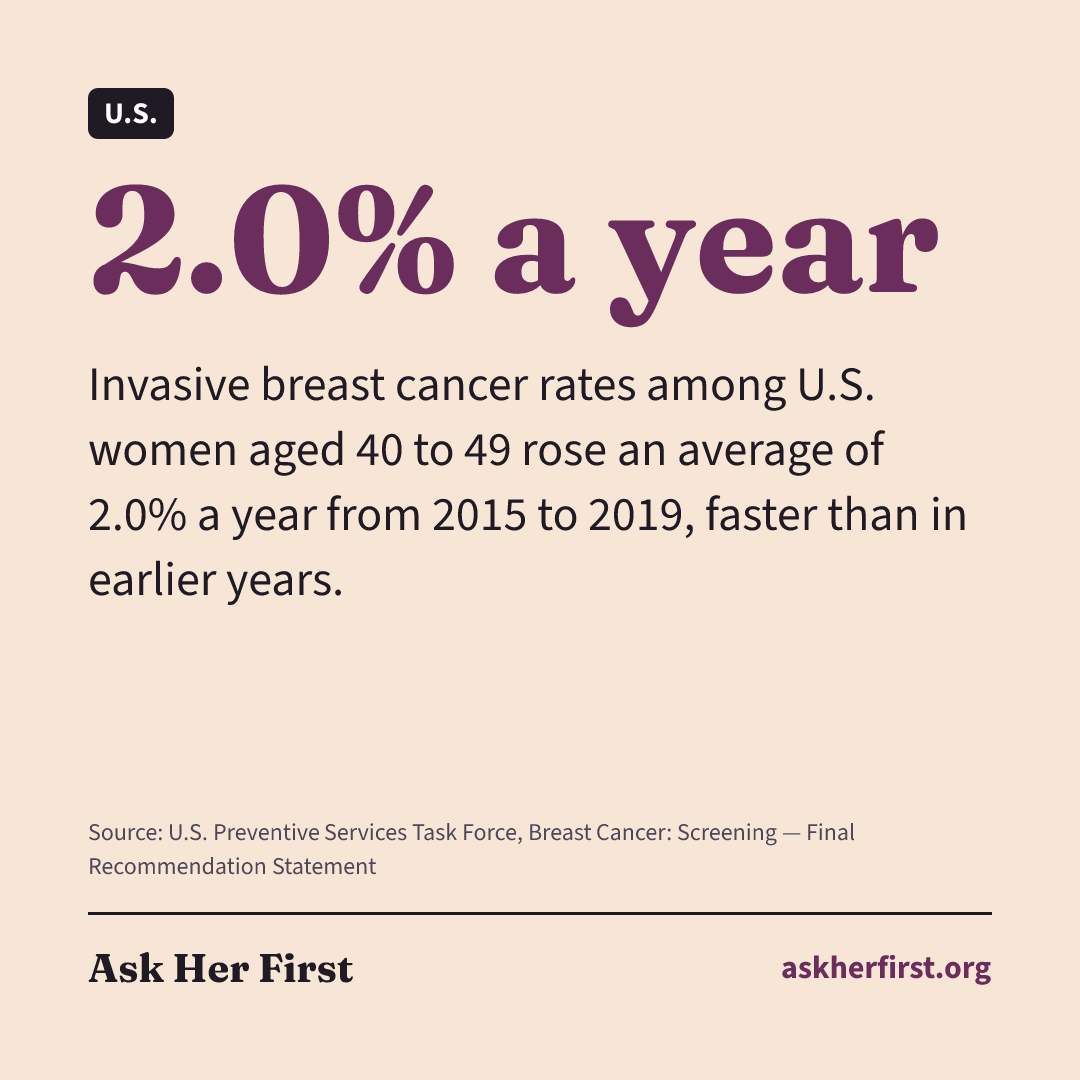
Rising rates in women in their 40s. Invasive breast cancer rates among U.S. women aged 40 to 49 rose an average of 2.0% a year from 2015 to 2019, faster than in earlier years.75 The USPSTF also relied on modeling studies. U.S.Models estimate that starting mammograms every other year at age 40 instead of 50 would prevent 1.3 more breast cancer deaths for every 1,000 women screened over a lifetime, and 1.8 more for every 1,000 Black women.75 Based on these factors, it concluded that mammograms for women aged 40 to 49 have a moderate benefit in reducing breast cancer deaths.75
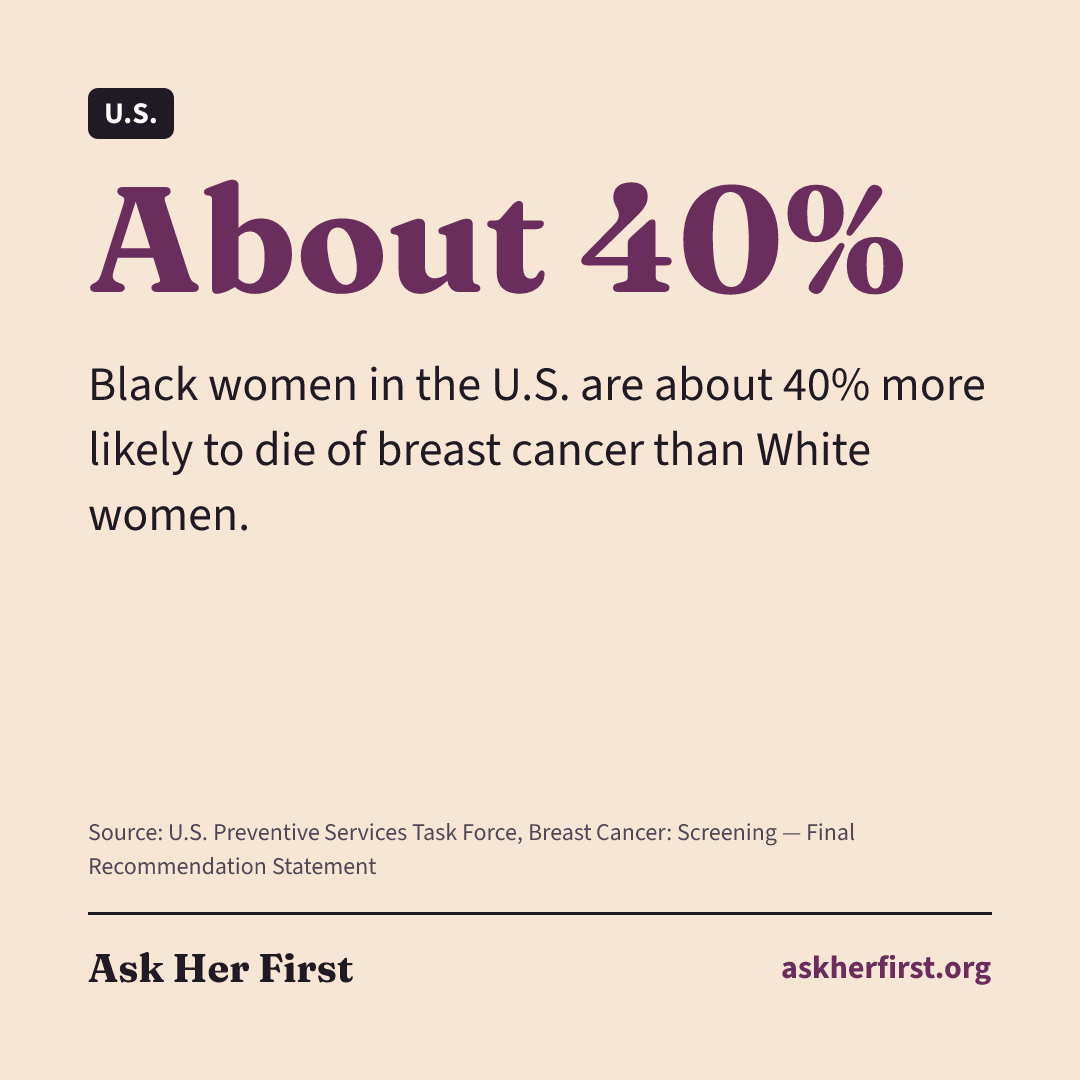
Higher death rates among Black women. Black women in the U.S. are about 40% more likely to die of breast cancer than White women.75 Black women are also more likely to be diagnosed after stage 1 and more likely to get triple-negative breast cancer, a more aggressive type, even though their self-reported mammogram rates are similar to or higher than those of other women.75 Triple-negative breast cancer, an aggressive type, is diagnosed about twice as often in Black women as in White women in the U.S. (24.2 vs. 12.3 cases per 100,000 women).75 The USPSTF says these cancers are harder to find with screening and respond less to current treatments.75
The USPSTF calls starting screening at 40 “an important first step” for Black women, but “not enough to improve these inequities.”75 It stresses that everyone with an abnormal mammogram needs fair and timely follow-up testing, including biopsies when needed, and that everyone diagnosed needs effective treatment.75
The trade-offs
Screening has harms as well as benefits. The USPSTF lists false-positive results, which can cause anxiety and lead to more tests and procedures; overdiagnosis and overtreatment of cancers that would never have caused problems; and radiation exposure.75 False positives are the most common harm.75
U.S.Models estimate that starting mammograms at 40 instead of 50 would lead to about 60% more false-positive results and 2 more overdiagnosed breast cancers for every 1,000 women over a lifetime of screening.75Dense breasts and the new notice
Breast density describes how much fibrous and glandular tissue your breasts have compared with fatty tissue, as seen on a mammogram.80 It has nothing to do with how your breasts look or feel.80
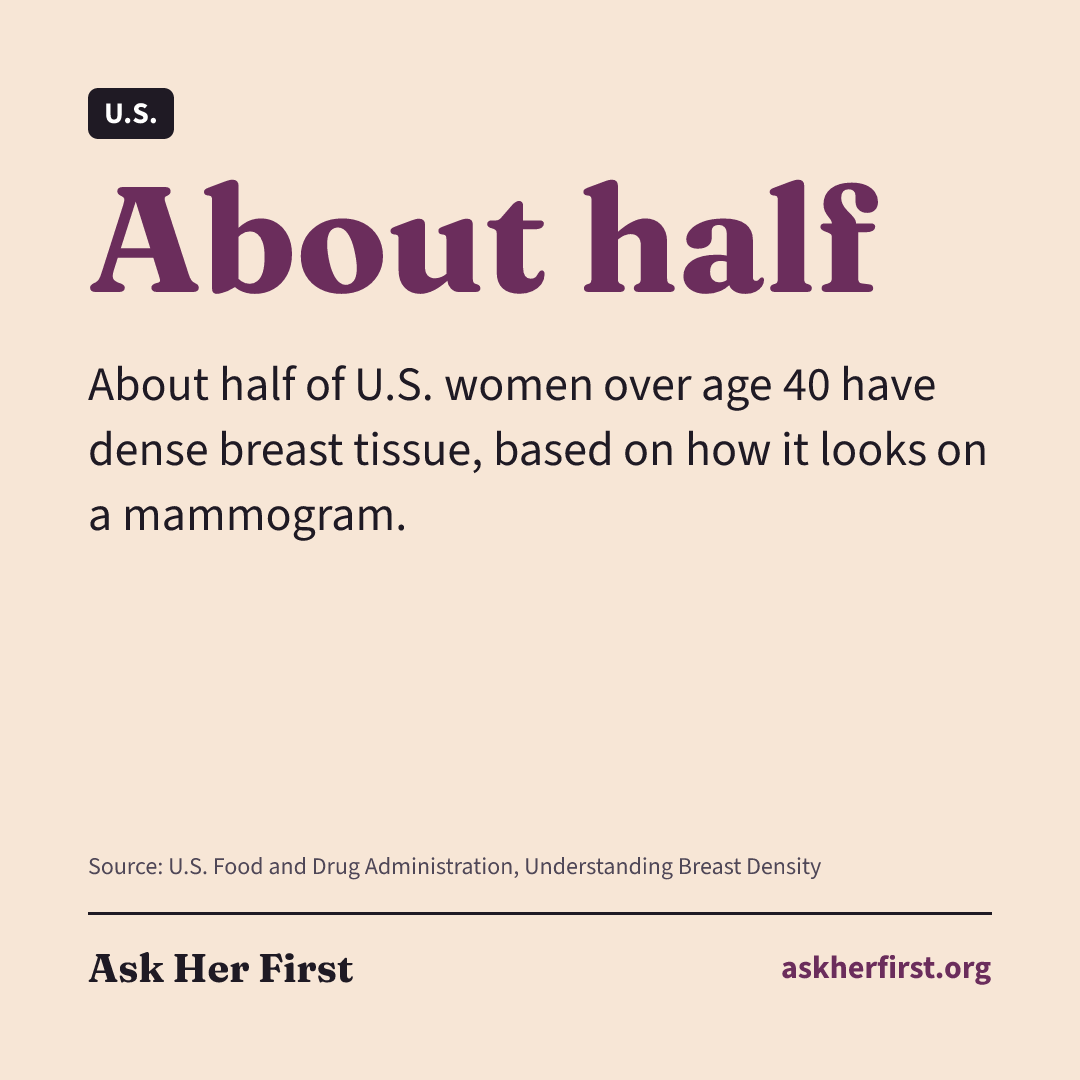
About half of U.S. women over age 40 have dense breast tissue, based on how it looks on a mammogram.78Dense tissue matters for two reasons: it can make cancer harder to see on a mammogram, and it is a risk factor for breast cancer.78 The CDC says the denser the breasts, the higher the risk.80 Still, according to data cited by the USPSTF, among women diagnosed with breast cancer, dense breasts on their own are not linked with a higher chance of dying from it once stage, treatment, and other factors are accounted for.75
What the FDA rule requires. The FDA issued a final rule on March 10, 2023, updating mammography regulations, and enforcement began on September 10, 2024.77 Every mammography facility must now send you a plain-language summary of your results within 30 days of your mammogram, and it must include your breast density.76 If the results are “suspicious” or “highly suggestive of malignancy,” the summary must come within 7 days.76
The regulation spells out the exact words you will see.76 If your breasts are dense, your summary says:
“Breast tissue can be either dense or not dense. Dense tissue makes it harder to find breast cancer on a mammogram and also raises the risk of developing breast cancer. Your breast tissue is dense. In some people with dense tissue, other imaging tests in addition to a mammogram may help find cancers. Talk to your healthcare provider about breast density, risks for breast cancer, and your individual situation.”76
If they are not dense, it says your tissue is not dense and still encourages you to talk with your provider about breast density, your breast cancer risk, and your situation.76 The report sent to your provider places your density in one of four categories, from “almost entirely fatty” to “extremely dense.”76,77
Extra imaging: what the evidence says
The notice says other tests “may help.” The USPSTF’s own review found the evidence is not there yet. It concluded that the current evidence is insufficient to weigh the benefits and harms of extra screening with breast ultrasound or MRI for women with dense breasts and an otherwise normal mammogram.75 It found no studies of supplemental ultrasound or MRI screening that reported effects on illness or death.75
An “insufficient evidence” finding is not a recommendation against extra imaging. The USPSTF says women with dense breasts should still start screening at 40 and should talk with their clinicians about options for follow-up testing.75 The CDC notes that your doctor may suggest a breast ultrasound or breast MRI.80
What we don’t know yet
The USPSTF issued “I statements,” meaning the evidence is insufficient, and called urgently for research in three areas:75
- How best to address disparities in screening and treatment for Black, Hispanic, Latina, Asian, Pacific Islander, Native American, and Alaska Native women
- Whether and how extra screening helps women with dense breasts
- The benefits and harms of screening women 75 and older
The USPSTF also wants more evidence on whether Black women might benefit from different screening strategies.75 Models suggest yearly screening for Black women could reduce the gap in deaths, but trial and observational evidence that yearly screening lowers deaths for any group is lacking.75 It is also unknown how many cases of ductal carcinoma in situ (DCIS), a noninvasive condition found through screening, are overdiagnosed.75
Questions to ask your doctor
- I’m 40 or older. When should I get my first (or next) mammogram?
- Does anything in my personal or family history put me at higher risk? Does this recommendation apply to me?
- Are my breasts dense? Which of the four density categories am I in?
- Given my density and risk, would ultrasound or MRI help me? What are the downsides, and would my insurance cover it?
- Should I have a 3D mammogram (tomosynthesis)?
- If I get a callback, how quickly will follow-up tests happen, and who will explain the results?
- I’m 75 or older. Should I keep getting mammograms?
This article summarizes published research and official health information. It has not been reviewed by a clinician and is not medical advice. How we source.