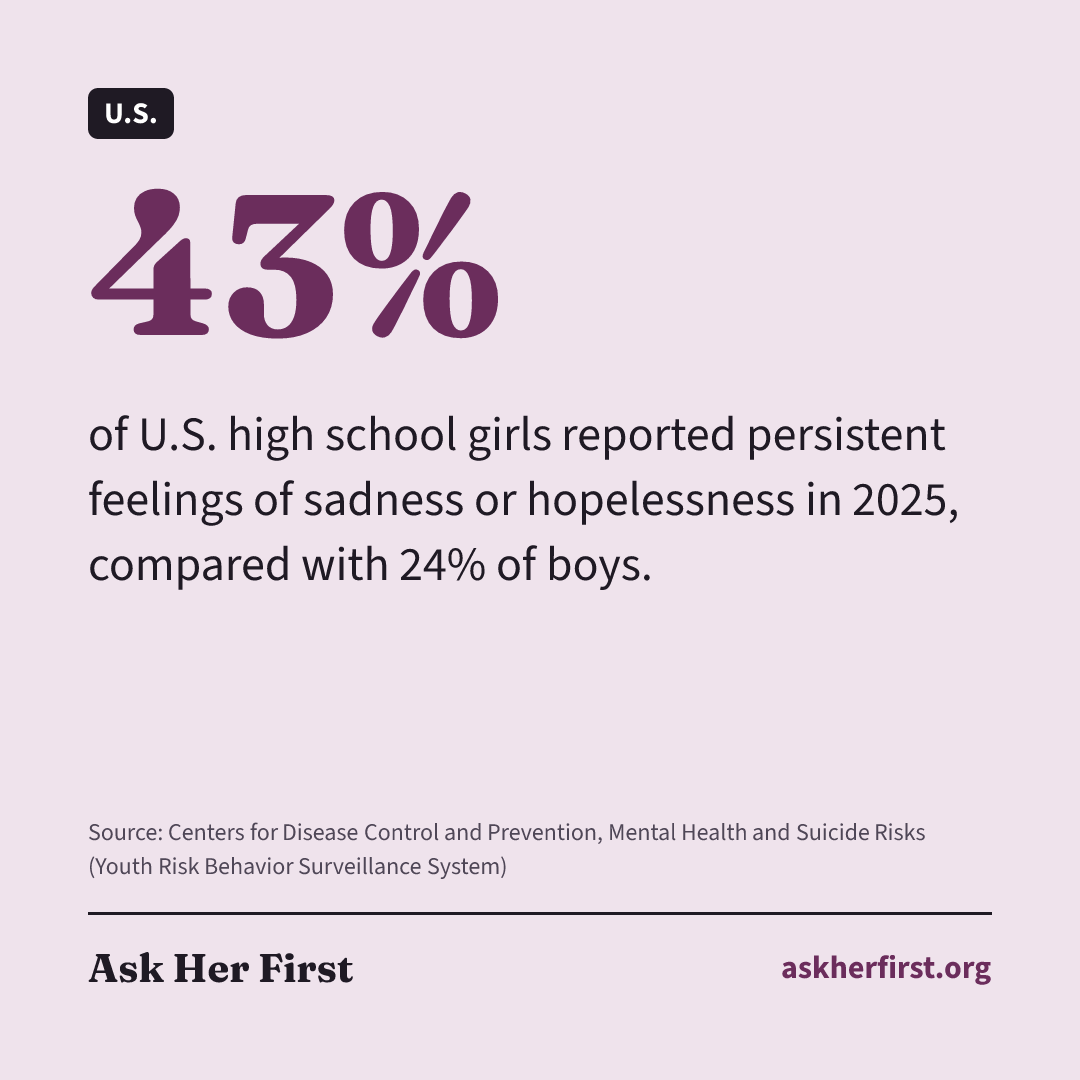
Many teen girls in the U.S. report persistent sadness or hopelessness. 43% of U.S. high school girls reported persistent feelings of sadness or hopelessness in 2025, compared with 24% of boys.17 In 2023, the U.S. Surgeon General issued an advisory warning that we do not yet have enough evidence to determine whether social media is sufficiently safe for children and adolescents.208 This page sums up what that advisory, CDC surveys, and researchers say, including where the evidence is still unclear.
How much teens use social media
Up to 95% of U.S. youth ages 13–17 report using a social media platform, and more than a third say they use social media “almost constantly.”208 Although age 13 is commonly the minimum age platforms require in the U.S., the advisory reports that many younger children also use social media.208
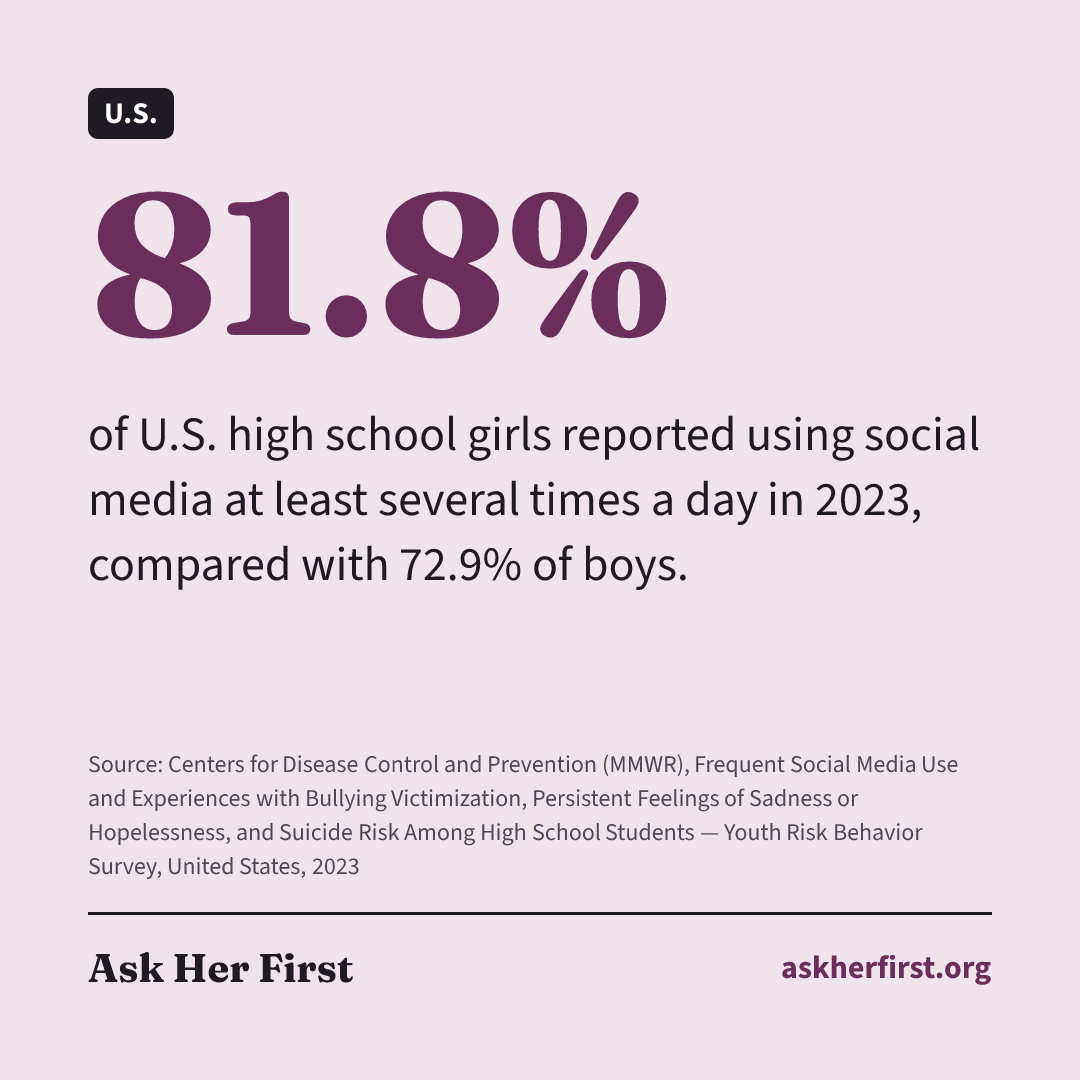
Girls use it more often than boys. 81.8% of U.S. high school girls reported using social media at least several times a day in 2023, compared with 72.9% of boys.209
What the Surgeon General’s advisory says
The advisory says social media has the potential to both benefit and harm children and adolescents, and that different young people are affected in different ways, based on their individual strengths and vulnerabilities.208 It says the effects depend on factors such as how much time young people spend on platforms, what content they see, and how much social media disrupts sleep and physical activity.208
The advisory points to adolescence as a sensitive time: adolescents ages 10 to 19 are going through a highly sensitive period of brain development, and in early adolescence the brain is especially susceptible to social pressures, peer opinions, and peer comparison.208 It notes research finding that social media use predicted a later drop in life satisfaction for girls ages 11–13 and boys ages 14–15.208
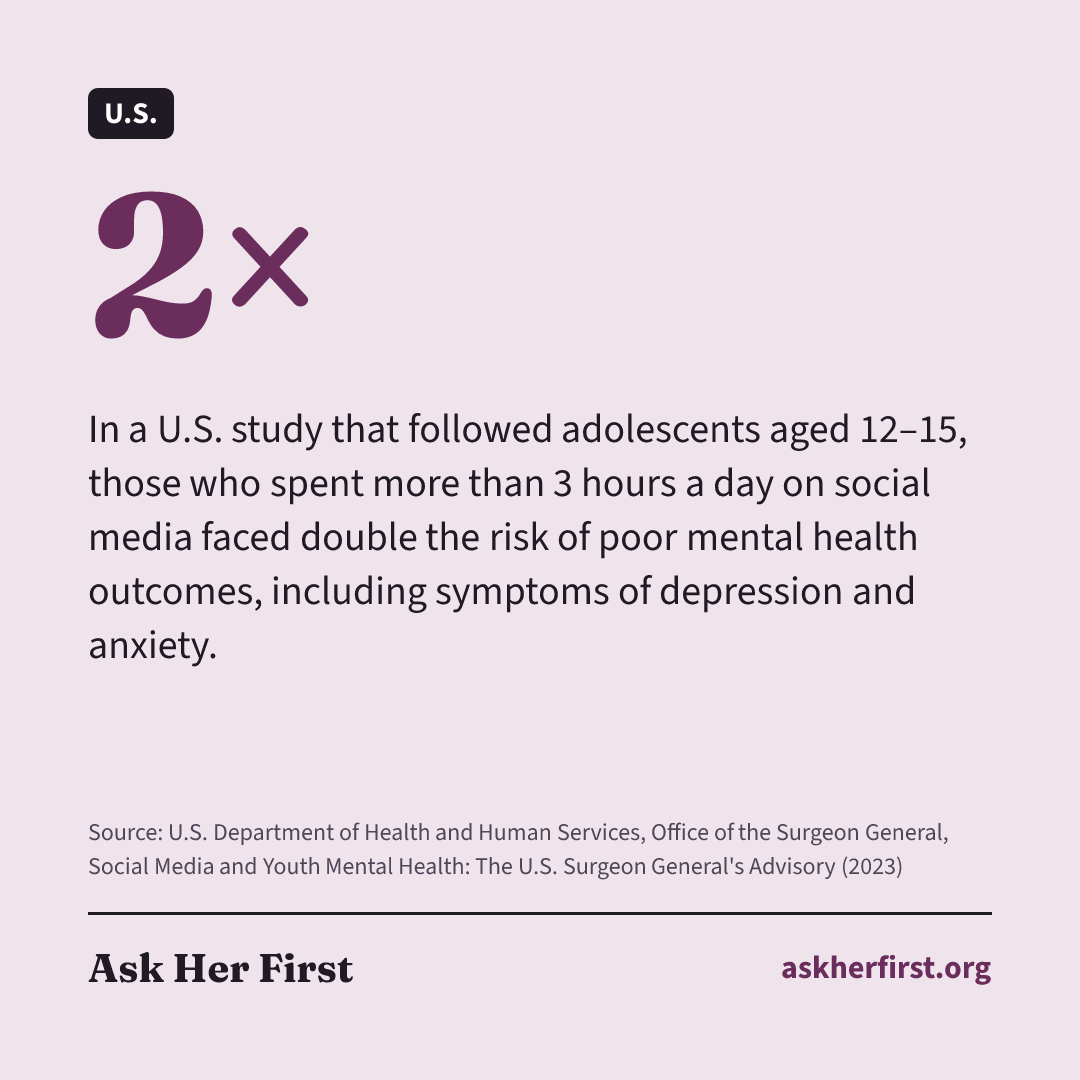
On time spent, it highlights one U.S. study. In a U.S. study that followed adolescents aged 12–15, those who spent more than 3 hours a day on social media faced double the risk of poor mental health outcomes, including symptoms of depression and anxiety.208 As of 2021, U.S. 8th and 10th graders spent an average of 3.5 hours a day on social media; 1 in 4 spent 5 or more hours.208
Risks named for girls
The advisory says correlational studies point to a higher relative concern of harm in adolescent girls and in young people already experiencing poor mental health.208
Body image and eating
According to the advisory, social media may perpetuate body dissatisfaction, disordered eating, social comparison, and low self-esteem, especially among adolescent girls.208 It cites a synthesis of 20 studies that found a significant relationship between social media use and body image concerns and eating disorders, with social comparison as a possible contributing factor.208 46% of adolescents aged 13–17 in one survey said social media makes them feel worse about their body image; 14% said it makes them feel better.208
Cyberbullying, harassment, and unwanted contact
The advisory reports that a review of 36 studies found a consistent relationship between cyberbullying on social media and depression among children and adolescents, and that adolescent girls and sexual minority youth are more likely to report being cyberbullied.208 It says adolescent girls and transgender youth are disproportionately affected by online harassment and abuse, which is associated with feeling sad, anxious, or worried.208 Nearly 6 in 10 adolescent girls in one survey said they had been contacted by a stranger on certain social media platforms in ways that made them feel uncomfortable.208
CDC data point the same way. In the 2023 national youth survey, frequent social media use was associated with a higher prevalence of being bullied at school and online, persistent sadness or hopelessness, and some measures of suicide risk.209 Girls who used social media frequently were more likely to be bullied than girls who used it less often.209
Sleep
The advisory cites a review of 42 studies that found a consistent relationship between social media use and poor sleep quality, shorter sleep, sleep difficulties, and depression among young people.208 It notes that poor sleep has been linked to changes in brain development, depressive symptoms, and suicidal thoughts and behaviors in adolescents.208
A large UK study helps show how these pieces may fit together. In that study, greater social media use was related to online harassment, poor sleep, low self-esteem, and poor body image, which in turn were related to higher depressive symptom scores.210 The link between social media use and depressive symptoms was larger for girls than for boys. In a UK study of 14-year-olds, girls who used social media 5 or more hours a day had depressive symptom scores 50% higher than girls who used it 1–3 hours; among boys, the increase was 35%.210
Harmful content and design
The advisory says harmful content, including content related to suicide and self-harm, remains easy for young people to reach, and it may be especially risky for those already struggling with their mental health.208 It also says platforms are often designed to maximize engagement, through features such as push notifications, autoplay, infinite scroll, and “likes,” which can encourage excessive use.208
The benefits are real, too
The advisory says social media can give some young people positive community and connection with others who share their identities, abilities, and interests, along with access to information and a space for self-expression.208 Online support from peers may be especially important for young people who are often marginalized, including racial, ethnic, and sexual and gender minorities.208 It also notes research suggesting that social media-based and other digital mental health tools may help some young people seek help and start mental health care.208
What the research shows, and what it doesn’t
Many studies find a link between social media use and poorer mental health in teens, but a link is not the same as proof that one causes the other.208,212 The CDC notes that its youth survey is cross-sectional, so causality and the direction of the links between frequent social media use and health cannot be established.209 The advisory itself calls the relationship between social media and youth mental health complex and potentially bidirectional.208
Findings are mixed. A 2020 research review found that most research had been correlational and focused on adults rather than adolescents, and had produced a mix of often conflicting small positive, negative, and null associations.212 The review said the most rigorous large studies found small associations between daily digital technology use and adolescent well-being, which could not distinguish cause from effect.212 A 2019 analysis of three large datasets found the association between digital technology use and adolescent well-being was negative but small.211 These studies measured overall digital technology use, not social media alone.211,212
Some experimental evidence exists, though mostly in older age groups.208 The advisory reports that a small randomized trial in college-aged youth found that limiting social media to 30 minutes a day for three weeks led to significant improvements in depression severity.208
What parents and caregivers can do
The advisory says the burden of protecting young people should not fall only on parents, and it also calls on policymakers, technology companies, and researchers to act.208 It suggests these steps for families:208
- Make a family media plan with agreed-upon expectations, such as screen time, content boundaries, and not sharing personal information.208
- Create tech-free zones. Consider keeping phones, tablets, and computers away for at least 1 hour before bedtime and through the night, and keeping meals and in-person gatherings device-free.208
- Model the behavior you want to see in your own social media use.208
- Talk about technology with your child: who they connect with, their privacy settings, their experiences online, and how to ask for help.208
- Report cyberbullying and online abuse or exploitation, and support your child without judgment if they tell you about it. The advisory points families to CyberTipline and Take It Down for reporting online exploitation.208
- Work with other parents to set shared norms.208
What teens can do
The advisory also offers steps for young people:208
- Reach out for help to a trusted friend or adult if social media is affecting you or someone you know. In a mental health crisis, call or text 988.208
- Set boundaries, such as no phones, tablets, or computers for at least 1 hour before bed and through the night.208
- Use protective tools and habits: track your time online, block unwanted contacts and content, and use privacy and safety settings.208
- Be careful about what you share, since posts are often public and can be stored permanently.208
- Don’t keep online harassment or abuse a secret. Tell someone you trust. If a dating partner is harassing or abusing you online, the advisory points to Love is Respect, and if private images of you were shared without permission, it points to Take It Down.208
What we don’t know yet
- Cause and effect. Most research so far has been correlational, focused on young adults or adults, and produced a range of results.208
- Which content and features do the most harm, for whom, and why. The advisory lists this as an open research question, along with who benefits most from social media.208
- Access to data. The advisory says a lack of access to data and transparency from technology companies has been a barrier to understanding social media’s full impact.208
- What protects young people. The advisory calls for research on which programs, policies, and design features protect children’s mental health online.208
- Data age. The advisory was published in 2023, and several of the surveys it cites are older.208 This page does not cover later policy changes because we could not verify them on a primary source.
Questions to ask your doctor
- My daughter seems more anxious, down, or withdrawn. How can we tell whether social media is part of it?
- Should her sleep, eating, or body image be checked?
- What signs would mean she needs more help than limiting screen time?
- Can you screen her for depression or anxiety, or refer us to someone who can?
- How can we talk about social media at home without pushing her away?
- If she is being bullied or harassed online, what support is available?
This article summarizes published research and official health information. It has not been reviewed by a clinician and is not medical advice. How we source.