Trying to get pregnant without success can be hard, and it can be hard to know when to ask for help. An infertility evaluation is a set of exams and tests to try to find out why you and your partner have not gotten pregnant.3 The American College of Obstetricians and Gynecologists (ACOG) says that if a cause is found, treatment may be possible, and that in many cases infertility can be treated successfully even if no cause is found.3
This page explains how health organizations define infertility, when each says an evaluation is recommended, what the tests may involve, and common causes. Where organizations word things differently, we show each one.
What infertility means
- World Health Organization (WHO): Infertility is a disease of the male or female reproductive system defined by the failure to achieve a pregnancy after 12 months or more of regular unprotected sexual intercourse.1
- Centers for Disease Control and Prevention (CDC): For public health data collection, CDC defines infertility as not being able to get pregnant after 1 year or longer of unprotected sex.2
- ACOG: Infertility is not getting pregnant after 1 year of regular sexual intercourse without using birth control.3
- American Society for Reproductive Medicine (ASRM): ASRM’s 2023 definition is broader. It describes infertility as a disease, condition, or status marked by any of these: being unable to achieve a successful pregnancy based on a person’s medical, sexual, and reproductive history, age, physical findings, or test results; needing medical help, such as donor eggs, sperm, or embryos, to achieve a successful pregnancy as an individual or with a partner; or, for people having regular unprotected sex with no known cause of reduced fertility, reaching the evaluation timelines in the next section.4 ASRM says nothing in the definition should be used to deny or delay treatment to anyone, regardless of relationship status or sexual orientation.4
- HHS Office on Women’s Health (OWH) and MedlinePlus: Both say infertility can also include being able to get pregnant but not stay pregnant; MedlinePlus mentions pregnancies that end in repeated miscarriage or stillbirth.5,6
WHO calls it primary infertility when a person has never achieved a pregnancy, and secondary infertility when at least one earlier pregnancy has been achieved.1
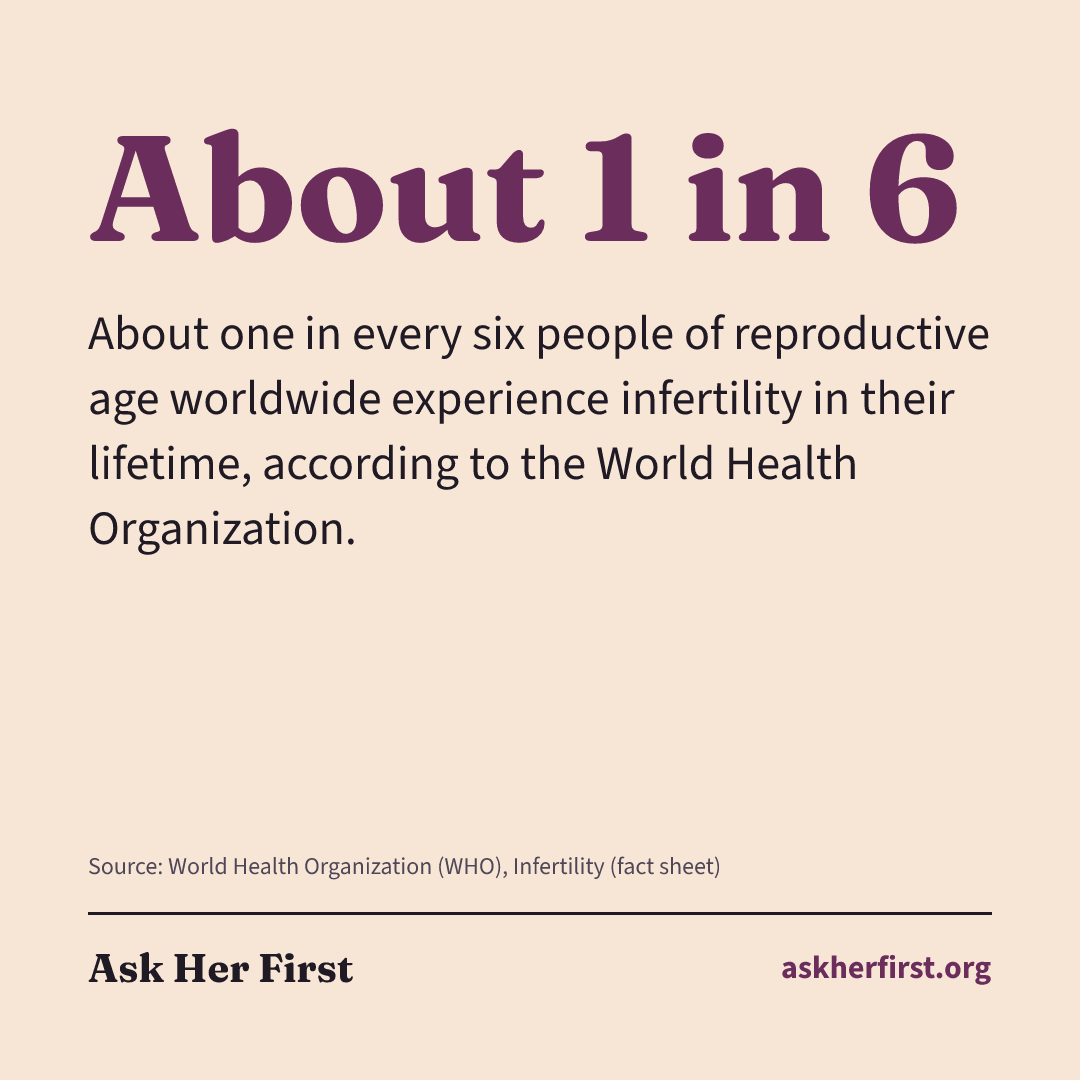
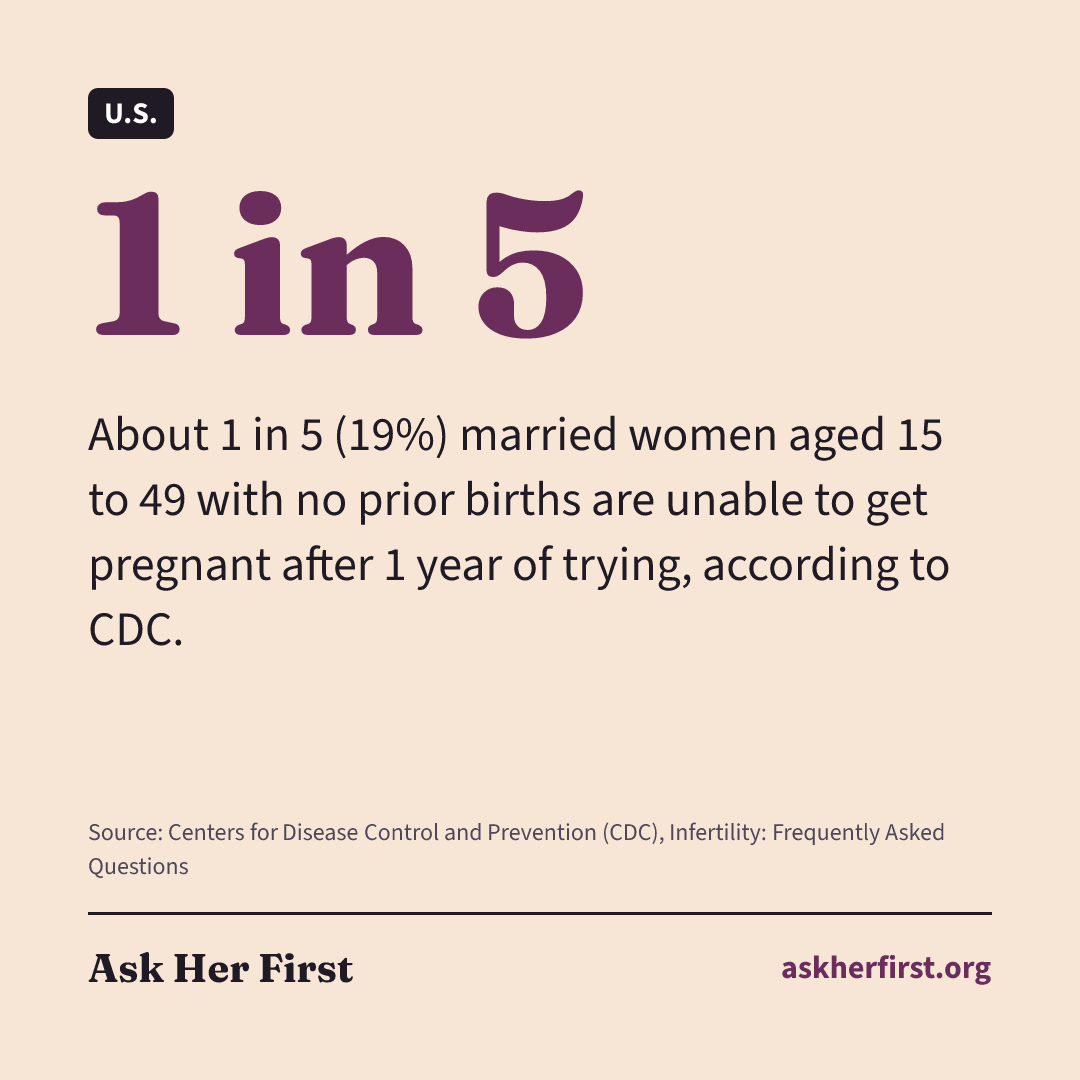
About one in every six people of reproductive age worldwide experience infertility in their lifetime, according to the World Health Organization.1 U.S.About 1 in 5 (19%) married women aged 15 to 49 with no prior births are unable to get pregnant after 1 year of trying, according to CDC.2When organizations recommend an evaluation
The timelines depend mostly on the age of the person who would carry the pregnancy.
Under 35. ACOG says experts recommend an evaluation if you have not gotten pregnant after 1 year of regular sex without birth control.3 ASRM says evaluation should start at 12 months when the female partner is under 35, for people having regular unprotected sex with no known cause of reduced fertility in either partner.4
35 and older. ACOG says an evaluation is recommended after 6 months of trying if you are older than 35.3 ASRM says evaluation should start at 6 months when the female partner is 35 or older.4 OWH says women 35 or older should see their doctors after six months of trying.5 CDC’s wording is softer: because fertility in women declines steadily with age, it says, some providers evaluate and treat women 35 or older after 6 months.2
Over 40. ACOG says that if you are older than 40, talk with your ob-gyn now about an evaluation.3 ASRM’s 2021 guidance says more immediate evaluation and treatment may be warranted for women over 40.7
These are the points at which organizations recommend an evaluation, not a rule that you must wait to ask questions. OWH says it is a good idea for any woman to talk to a doctor before trying to get pregnant.5
Reasons to seek an evaluation sooner
Some health histories are reasons not to wait the usual 6 or 12 months. CDC says couples with these signs or symptoms should not delay seeing their health care provider when they are trying to become pregnant:2
- For women: irregular periods or no periods; a history of endometriosis or very painful periods; a history of pelvic inflammatory disease; known or suspected uterine or tubal disease; a history of more than one miscarriage; or genetic or acquired conditions that can diminish ovarian reserve (the supply of eggs)
- For men: a history of testicular trauma, prior hernia surgery, prior chemotherapy, a history of infertility with another partner, or sexual dysfunction
ASRM’s list overlaps but is not identical. It says testing should start without delay for conditions known to cause infertility, including irregular cycles, cycles shorter than 25 days, bleeding between periods, or infrequent or absent periods; known or suspected uterine, tubal, or peritoneal disease, or endometriosis; known or suspected reduced fertility in a male partner; sexual dysfunction; and conditions that can lower ovarian reserve, such as chemotherapy, radiation exposure, or the FMR1 premutation.7
If you have had more than one pregnancy loss, our guide to pregnancy loss covers what is known about causes and getting pregnant again.
It involves both partners
CDC says both men and women can contribute to infertility.2 ACOG says the most common cause of male infertility is a problem with sperm cells and how they function.3
ASRM says that when a male partner is contributing to the pregnancy, evaluation of both partners should begin at the same time, with his reproductive and medical history and at least one semen analysis at the start, because a contributing male factor is common.7
ASRM also says single women, women in same-sex relationships, and other women who need donor sperm should have a history, physical exam, and lab evaluation similar to any other infertility patient, and that transgender men and nonbinary patients who want fertility treatment need the same kind of targeted evaluation.7
What an evaluation may involve
You may not have every test described here; ACOG says some are done based on the results of earlier ones.3 ASRM says evaluation should start with the least invasive methods for finding the most common causes.7 ACOG says that in most cases an evaluation can be finished within a few menstrual cycles.3
Who does it and the first visit
ACOG says your ob-gyn usually does the first assessment, and you may also see a reproductive endocrinologist, an ob-gyn with special training in infertility; men may see a urologist.3 The first visit usually includes a detailed medical history and a physical exam, with questions about your periods, pelvic pain, past pregnancies, medications, tobacco, alcohol, and drug use, and your sexual history, including how long you have been trying.3
Checking ovulation
ASRM says a thorough menstrual history may be all that is needed, and that women with regular cycles between 21 and 35 days don’t need more testing to confirm ovulation unless they have excess hair growth (hirsutism).7 When more information is needed, ACOG lists a progesterone blood test taken about 1 week before your expected period, urine tests that detect the hormone surge that triggers ovulation, and ultrasound.3 ACOG also lists blood tests for thyroid function and the hormone prolactin.3
Ovarian reserve tests
These tests estimate the supply of eggs. ASRM lists blood tests for anti-Müllerian hormone (AMH) and early-cycle follicle-stimulating hormone (FSH) and estradiol, and an ultrasound count of small follicles in the ovaries (antral follicle count).7 The next section explains their limits.
Looking at the uterus and fallopian tubes
According to ACOG:3
- Sonohysterography is a special ultrasound that looks for scarring or other problems inside the uterus.
- Hysterosalpingography (HSG) is an X-ray procedure that shows the inside of the uterus and whether the fallopian tubes are blocked.
- Hysteroscopy uses a thin camera passed through the cervix to look inside the uterus and guide minor surgery.
- Laparoscopy uses a thin camera inserted through the abdomen to show the tubes, ovaries, and outside of the uterus.
ASRM says tubal disease is an important cause of infertility that should be specifically ruled out, and recommends HSG or sonohysterography to check whether the tubes are open.7 It says laparoscopy is not recommended for routine evaluation unless pelvic disease is suspected or there is another specific reason, such as severe period pain.7
Testing for men
ACOG says testing for a man often involves a semen analysis, which looks at the amount of sperm, their shape, and how they move, and may include blood tests for male reproductive hormones and sometimes an ultrasound of the scrotum.3
What ovarian reserve tests can and can’t tell you
Ovarian reserve tests can sound like a general fertility check, but ASRM describes clear limits. In a 2020 committee opinion, ASRM says these markers can help predict how many eggs may be retrieved after ovarian stimulation, but they are poor predictors of the ability to get pregnant, independent of age.8
ASRM’s evaluation guidance adds that a woman’s age is the single most important predictor of her chance of getting pregnant, and that a poor ovarian reserve result does not necessarily mean a person cannot get pregnant.7 In women without infertility, results suggesting a low egg supply do not predict short-term chances of pregnancy, and ASRM says the tests should not be used as a screening test for women who don’t meet the criteria for infertility.7 Their main use, ASRM says, is to help tailor treatment and set realistic expectations about how the ovaries may respond to fertility medicines.7
Common causes
ACOG says age, lifestyle, and health conditions can affect fertility, and that sometimes no cause is found, which is called unexplained infertility.3
Ovulation problems. ACOG says the most common cause of female infertility is a problem with ovulation.3 Ovulation problems account for up to 40% of infertility in women, according to the American Society for Reproductive Medicine.7 OWH calls polycystic ovary syndrome (PCOS) the most common cause of female infertility.5 Read more: PCOS explained, which also covers the proposed new name, PMOS. Primary ovarian insufficiency (POI) is another cause; OWH says it happens when the ovaries stop working normally before age 40.5
Blocked or damaged fallopian tubes. ACOG lists scarring or blockages of the tubes, from past sexually transmitted infections (STIs) or endometriosis, among problems that can affect fertility.3 OWH adds pelvic inflammatory disease and surgery for an ectopic pregnancy.5
Endometriosis. WHO lists endometriosis among uterine disorders that can cause female infertility.1 Read more: Endometriosis: effects on fertility.
Fibroids, polyps, and other uterine conditions. MedlinePlus lists growths such as fibroids or polyps in the uterus and cervix among causes of female infertility.9 ASRM says polyps are the most common uterine abnormality found in women being evaluated for infertility.7 Read more: Uterine fibroids.
Age. CDC says fertility declines with age mainly because egg quality declines, and that older women also have fewer eggs left and are more likely to have health conditions that can cause fertility problems.2 For healthy couples in their 20s or early 30s, ACOG says the chance of pregnancy in any single menstrual cycle is about 25 to 30 percent.3 ACOG says this starts to decline in a woman’s early 30s and declines more rapidly after 37.3 By age 40, ACOG says a woman's chance of getting pregnant drops to less than 10 percent per menstrual cycle.3 A man’s fertility also declines with age, but not as predictably.3
Factors in men. ACOG says infertility in men can be caused when the tubes that carry sperm from the testicles are blocked.3 OWH names varicocele, enlarged veins on the testicles, as a common cause.5
Lifestyle. ACOG says women who are underweight, overweight, or exercise too much may have a harder time getting pregnant, and that smoking and moderate or heavy drinking may reduce women’s fertility; in men, smoking, heavy drinking, and marijuana use can reduce sperm count and movement.3
Treatment options at a glance
This is a brief overview, not a guide to choosing treatment. MedlinePlus says treatment depends on the cause, how long you have been trying, and your age.6 CDC says options may include timed intercourse, medications, intrauterine insemination, surgery, or assisted reproductive technology.2 OWH says most infertility is treated with drugs or surgery.5
- Medicines to cause ovulation. ACOG says these are used when ovulation is irregular or doesn’t happen and other causes have been ruled out; they include pills such as clomiphene citrate and aromatase inhibitors, and injected gonadotropins.10
- Surgery. ACOG says surgery may be used to repair blocked or damaged tubes, treat endometriosis, or remove polyps or fibroids in the uterus.10
- Intrauterine insemination (IUI). Sperm from a partner or donor is placed in the uterus as close to ovulation as possible, sometimes along with ovulation medicines.10
- In vitro fertilization (IVF). Sperm and eggs are combined in a lab and an embryo is transferred to the uterus; ACOG says it may take more than one cycle to succeed.10
ACOG says multiple pregnancy (twins or more) is a risk with ovulation drugs and IVF, and that ovulation stimulation can lead to ovarian hyperstimulation syndrome, which is usually mild but can need a hospital stay in severe cases.10
Cost and insurance
ACOG says some insurance companies may cover the cost of an infertility evaluation, and suggests calling your insurer before you start.3 ACOG also says treatment takes time and can have high costs, and some treatments are expensive and may not be covered by insurance.10
The emotional side
OWH says finding the cause of infertility can be a long and emotional process.5 MedlinePlus says evaluation and treatment are stressful for most couples, and that emotional stress may lead to depression, anger, anxiety, and conflict between partners.9 WHO says infertility has significant negative social effects, particularly for women, who frequently experience violence, divorce, social stigma, emotional stress, depression, anxiety, and low self-esteem.1
MedlinePlus says counseling and support groups may help you and your partner cope, and suggests asking your provider to recommend local groups.6,9 Our guide to finding mental health care explains the kinds of providers and how to get started.
What we don’t know yet
- Timelines don’t fully match. ACOG recommends evaluation after 6 months for women older than 35, and ASRM at 35 or older, while CDC says only that some providers do this.2,3,4 MedlinePlus’s encyclopedia uses a different cutoff, saying providers suggest women under 30 try for 1 year before testing and women over 35 try for 6 months.9
- Definitions differ. ASRM’s 2023 definition counts people who need medical help, such as donor eggs, sperm, or embryos, to get pregnant, while WHO’s definition is based on 12 months of trying.1,4
- What the numbers cover. The CDC figure covers only married women with no prior births, so it doesn’t describe everyone.2
- How current the guidance is. ACOG’s evaluation FAQ was first published in April 2020 and last reviewed in May 2026.3 In November 2025, WHO issued its first global guideline on infertility, so recommendations may keep changing.1
Questions to ask your doctor
- Based on my age and history, when do guidelines suggest I should be evaluated? Is there a reason to start now?
- Should my partner be evaluated at the same time?
- Which tests do you recommend first, and why? Which ones might I not need?
- Should we check whether my tubes are open? Would that be an HSG or a sonohysterography?
- What will an ovarian reserve test tell us, and what won’t it?
- Could my periods, pain, or past infections, surgery, or cancer treatment be affecting my fertility?
- When would you refer me to a reproductive endocrinologist?
- What parts of the evaluation and treatment are likely to be covered by my insurance?
- Where can I find counseling or a support group?
This article summarizes published research and official health information. It has not been reviewed by a clinician and is not medical advice. How we source.
A printout or saved PDF is a copy someone else could find.