Uterine fibroids are growths that develop from the muscle tissue of the uterus, and they are not cancer.3 They are the most common type of growth found in a woman’s pelvis.3 Many women with fibroids have no symptoms, but for others they cause heavy or painful periods, pressure, or other problems.4 This page explains who gets fibroids, how they are found, and what medical sources say about treatment options.
What fibroids are
Fibroids are also called leiomyomas or myomas.3 They can grow as a single growth or in clusters, and one uterus often has many fibroids of different sizes.5 Fibroids can grow, shrink, or stay the same size over time, and a fibroid may stay small for a long time and then grow quickly.3,5
Health care providers group fibroids by where they grow:5
- Submucosal fibroids grow just under the lining of the uterus and into the inside of the uterus.
- Intramural fibroids grow within the muscle wall of the uterus.
- Subserosal fibroids grow on the outside of the uterus.
- Pedunculated fibroids grow on stalks, either out from the surface of the uterus or into its cavity.
No one knows for sure what causes fibroids.1 The hormones estrogen and progesterone appear to be involved in their growth, and fibroids often shrink at menopause, when estrogen levels fall.3
How common fibroids are and who gets them
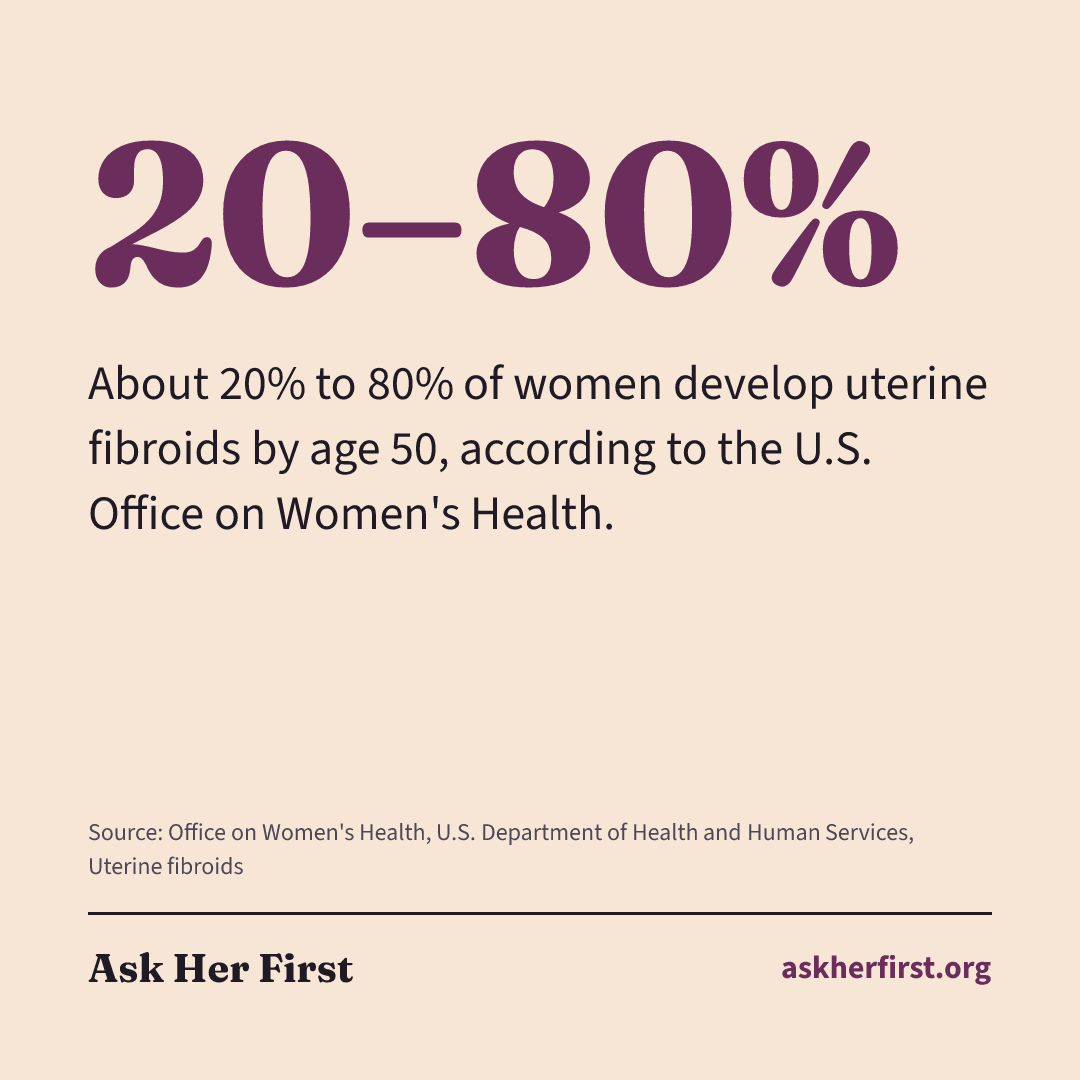
About 20% to 80% of women develop uterine fibroids by age 50, according to the U.S. Office on Women's Health.1 The U.S. Office on Women’s Health (OWH) says they are most common in women in their 40s and early 50s.1
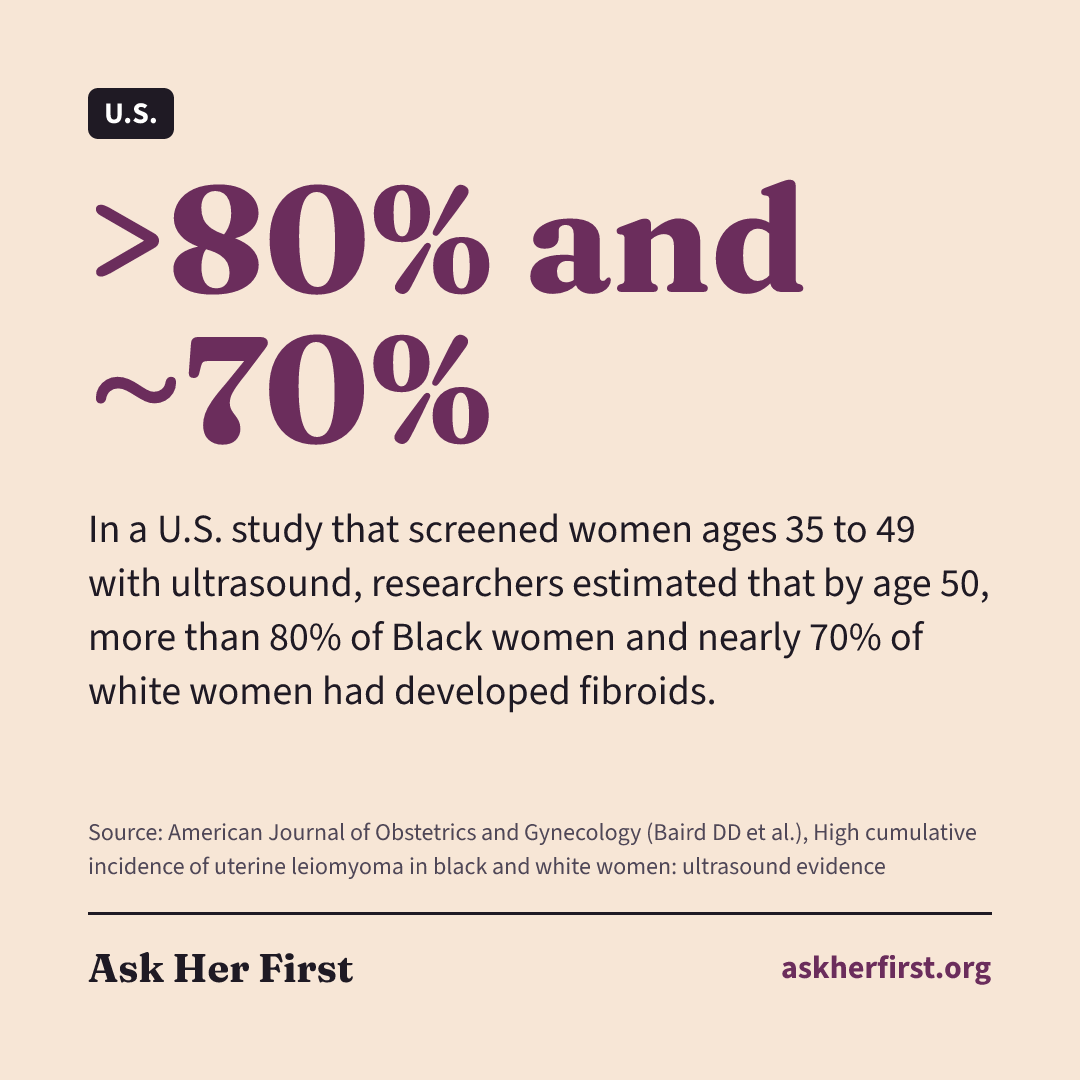
Fibroids occur more often in Black women than in white women, and they seem to occur at a younger age and grow more quickly in Black women.3 According to the National Institute of Child Health and Human Development (NICHD), fibroids in African American women typically develop at a younger age, grow larger, and cause more severe symptoms.6 In a U.S. study that screened women ages 35 to 49 with ultrasound, researchers estimated that by age 50, more than 80% of Black women and nearly 70% of white women had developed fibroids.2 The American College of Obstetricians and Gynecologists (ACOG) says these differences may be due to racism and inequities in society, which can increase the risk of health problems.3
Other factors NICHD lists as possibly raising risk include older age, obesity, a family history of fibroids, high blood pressure, never having been pregnant, and vitamin D deficiency.6 These are links found in research, not proof that any one factor causes fibroids.
Symptoms
Most fibroids do not cause symptoms.1 When they do, symptoms can include:3,4
- Heavy, longer, or more frequent periods, bleeding between periods, and anemia from blood loss
- Painful periods, or lower back pain
- A feeling of fullness or pressure in the lower belly (pelvic pressure)
- Frequent urination, from a fibroid pressing on the bladder
- Constipation, rectal pain, or difficult bowel movements
- Pain during sex
- An enlarged uterus and belly
- Reproductive problems, which are covered below
The size of a fibroid does not seem to match how bad the symptoms are, so even small fibroids can cause considerable symptoms and heavy periods, according to NICHD.7
Fibroids are only one possible cause of these symptoms. Other guides cover them in depth: heavy periods and iron deficiency, period pain, and painful sex.
When to get checked, and when to get care sooner
MedlinePlus, from the National Library of Medicine, says to contact your provider if you have heavy bleeding, increased cramping, bleeding between periods, or fullness or heaviness in your lower belly.8
Most fibroids do not cause problems, but complications can happen.3 A fibroid attached to the uterus by a stalk may twist and cause pain, nausea, or fever, and fibroids that grow rapidly or start breaking down may also cause pain.3 MedlinePlus lists severe pain or very heavy bleeding that needs emergency surgery among possible complications.8 For the bleeding signs ACOG says need emergency care, see When to see a doctor in our heavy periods guide.
Fibroids, fertility, and pregnancy
Sources describe fertility effects with different strength, so it helps to know who says what:
- ACOG says fibroids may cause infertility, although other causes are more common, and that other factors should be explored before fibroids are considered the cause.3 When fibroids are thought to be a cause, many women are able to get pregnant after they are treated.3
- OWH describes infertility from fibroids as very rare.1
- NICHD lists reproductive problems among possible symptoms, but also describes a study of couples having fertility treatment that found fibroids did not reduce a woman’s chance of a successful pregnancy.4,9
If you are trying to get pregnant and it isn’t happening, our guide to infertility evaluation explains when evaluation is recommended and what it involves.
During pregnancy. Women with fibroids are more likely to have problems during pregnancy and delivery, but OWH says this doesn’t mean there will be problems, and most women with fibroids have normal pregnancies.1 The problems OWH lists as most common are needing a cesarean birth, a baby in breech position, labor that doesn’t progress, placental abruption (the placenta separating from the uterus before delivery), and preterm birth.1
How fibroids are diagnosed
Fibroids are often first found during a routine pelvic exam, sometimes when you are being checked for something else.3 During the exam, the uterus may feel larger than normal or irregularly shaped.7
Tests that can show more about fibroids include:1,3
- Ultrasound, with the probe on the belly or inside the vagina
- Sonohysterography, an ultrasound after fluid is placed in the uterus
- Hysteroscopy, a thin lighted scope passed through the cervix to see inside the uterus
- Hysterosalpingography, a special X-ray of the uterus and fallopian tubes
- Laparoscopy, a thin scope inserted through a small cut near the belly button
- MRI and CT scans, which ACOG says may be used but are rarely needed
Some of these tests may be used to track fibroid growth over time.3 If you have unusual bleeding, a provider may also take a small sample of the uterine lining (endometrial biopsy) to check for cancer.8
Treatment options
There are many treatment options for fibroids.3 Things a provider considers include your symptoms, your age and general health, how close you may be to menopause, the type, size, and location of the fibroids, and whether you want to get pregnant in the future.1,10 A 2017 review for the Agency for Healthcare Research and Quality (AHRQ) concluded that a range of treatments are effective for reducing fibroid size and improving symptoms, that few studies directly compare them, and that choosing among them is likely best done in the context of each patient’s needs and preferences.11
This section describes what medical sources say. It isn’t personal advice; a clinician can help you work out what fits your situation.
Watchful waiting
Fibroids that don’t cause symptoms, are small, or occur in a woman nearing menopause often don’t need treatment.3 ACOG lists signs that may point to a need for treatment: heavy or painful periods that cause anemia or disrupt normal activities, bleeding between periods, uncertainty about whether a growth is a fibroid or another kind of tumor, rapid growth, infertility, and pelvic pain.3
Medicines
ACOG says medicines may reduce the heavy bleeding and painful periods fibroids can cause, but they may not stop fibroids from growing, and surgery is often needed later.3 Options sources describe include:
- Hormonal birth control, such as the pill, often used to control heavy bleeding and painful periods.3 Sources differ on growth: ACOG and NICHD say it can sometimes cause fibroids to grow larger, while OWH says low-dose birth control pills do not make fibroids grow.1,3,12
- A hormonal (progestin-releasing) IUD, which reduces heavy and painful bleeding but does not treat the fibroids themselves; ACOG says it is an option for fibroids that do not distort the inside of the uterus.3
- Tranexamic acid, which reduces blood loss during your period but does not stop periods.3
- GnRH agonists, which stop the menstrual cycle and can shrink fibroids, and are sometimes used before surgery.3 Because of side effects such as bone loss, they are used for a limited time, and fibroids usually return to their previous size afterward.3
- GnRH antagonists combined with hormonal “add-back” therapy, which can treat heavy bleeding for up to 2 years but do not shrink fibroids.3 Two oral medicines of this type are FDA-approved for heavy menstrual bleeding from fibroids in premenopausal women: Oriahnn (elagolix, estradiol, and norethindrone acetate), first approved in 2020, and Myfembree (relugolix, estradiol, and norethindrone acetate), first approved in 2021.13,14 Both labels limit use to 24 months because of the risk of bone loss that may not be reversible, and both carry a boxed warning that estrogen and progestin combinations increase the risk of blood clots and vascular events.13,14
If you have heavy bleeding, OWH says an iron supplement can help prevent or correct anemia.1 Our heavy periods guide explains iron testing and treatment.
Procedures that keep the uterus
- Myomectomy is surgery that removes the fibroids and leaves the uterus in place.3 Because you keep your uterus, you may still be able to have children, but ACOG says myomectomy sometimes causes internal scarring that can lead to infertility, and you may need a cesarean birth in a later pregnancy.3 Removed fibroids do not regrow, but new ones may develop.3
- Uterine artery embolization (UAE), also called uterine fibroid embolization, injects tiny particles into the blood vessels that feed the uterus, cutting off blood flow so fibroids shrink.3,15 ACOG says its effect on future pregnancies is not clear; NICHD notes an increased risk of miscarriage has been reported, and says most providers do not recommend UAE for women who want to have children.3,15
- Radiofrequency ablation uses heat to shrink fibroids through small incisions, or through the vagina or cervix.3 ACOG says complications are not common and more research is needed on its effect on future pregnancies.3 OWH describes it as not yet a standard treatment, so it may not be offered or covered by insurance.1
- MRI-guided focused ultrasound directs ultrasound waves through the skin to destroy fibroids; ACOG says more research is needed to say whether it works.3
- Endometrial ablation, which destroys the lining of the uterus, is used for small fibroids inside the uterus.15 Our heavy periods guide explains what it means for future pregnancy.
Treatment may need to be repeated. In the AHRQ review, rates of a later fibroid treatment two years after the first were lowest after medical management and higher after UAE and myomectomy, especially among younger women.11
Hysterectomy
Hysterectomy, removing the uterus, is the only sure way to cure fibroids, and fibroids are the most common reason hysterectomies are done.1 ACOG says it is done when other treatments have not worked or are not possible, or when the fibroids are very large, and that you can no longer have children afterward.3 OWH describes hysterectomy as major surgery that is usually quite safe but carries a significant risk of complications, with recovery that usually takes several weeks.1
Fibroids and cancer
A cancer that looks like a fibroid, called leiomyosarcoma, is rare, and OWH says having fibroids does not increase the risk of this cancer or of other cancers of the uterus.1 A 2017 review for the Agency for Healthcare Research and Quality estimated that among 10,000 women having surgery for presumed fibroids, between 0 and 13 will be found to have a leiomyosarcoma.11
That rare risk is behind an FDA safety warning about a surgical tool. Laparoscopic power morcellators allow some fibroid surgeries to be minimally invasive, which typically reduces infection risk and shortens recovery compared with open abdominal surgery.16 When they are used in myomectomy or hysterectomy, there is an increased risk of spreading unsuspected cancer, and benign tissue, within the belly and pelvis.16 In its most recent safety communication, issued December 29, 2020, the FDA recommends limiting power morcellation to certain appropriately selected patients and, when it is used, performing it only inside a tissue containment system.16 The FDA says the risk of unsuspected cancer increases with age, particularly over 50, and it recommends against using these devices for suspected fibroids in people who are postmenopausal or over 50.16
If your provider recommends laparoscopic hysterectomy or myomectomy, the FDA suggests asking whether power morcellation will be used, why it is appropriate for you, whether a containment system will be used, and whether other options are available.16
What we don’t know yet
- What causes fibroids. No one knows for sure, so we also don’t know what makes them grow or shrink.1 NICHD-supported research is studying genetics, hormones, the immune system, and environmental factors.9
- Why Black women are more affected. A gene change called MED12 has been linked to fibroids, but NICHD notes that Black women, who have the highest risk, are not more likely than other groups to have it.9 ACOG points to racism and inequities as possible reasons for the differences.3
- How treatments compare. The AHRQ review found few well-conducted trials that directly compared treatments, and no studies designed to evaluate watchful waiting.11 It found no characteristics of women or their fibroids that clearly predicted who would benefit, and its findings were limited by the number and size of studies.11 It included studies published through September 2016, before the GnRH antagonist combination medicines were approved.11,13
- How current the guidance is. ACOG’s patient FAQ was last updated in July 2022 and reviewed in December 2025, and NICHD’s fibroid pages were last reviewed in 2018.3,5 Estimates of how common fibroids are vary: OWH gives a wide range, and one U.S. study found fibroids on ultrasound in many premenopausal women who had never been diagnosed.1,2
Questions to ask your doctor
Questions like these may help. OWH, whose own list includes several of them, says a second opinion is a good idea if your questions haven’t been answered completely.1
- How many fibroids do I have, how big are they, and where are they?
- Do I need treatment now, or can we watch them? How will we track whether they grow?
- Which treatments fit my plans for pregnancy, now or later?
- For each option, what are the benefits, risks, side effects, and recovery time, and how likely am I to need another treatment?
- Is my bleeding heavy enough to check my iron levels?
- If you recommend surgery, will power morcellation be used, and if so, why and with a containment system?
- What are your views on hysterectomy compared with other treatments?
This article summarizes published research and official health information. It has not been reviewed by a clinician and is not medical advice. How we source.
A printout or saved PDF is a copy someone else could find.