If you think you or someone else may be having a stroke, call 911 right away.1,2 The Centers for Disease Control and Prevention (CDC) says to note the time when any symptoms first appear, because this helps health care providers decide on the best treatment.2 Fast treatment can lessen the brain damage a stroke can cause.2
A stroke happens when something blocks blood supply to part of the brain or when a blood vessel in the brain bursts.3 This guide covers the signs, what to do, what happens at the hospital, and the risk factors that affect women in particular.
What to do right now
- Call 911 right away. CDC says to call 9-1-1 right away if you or someone else has any stroke symptoms.2
- Don’t drive. CDC and the National Heart, Lung, and Blood Institute (NHLBI) say not to drive to the hospital or let someone else drive you; call an ambulance so medical personnel can begin lifesaving treatment on the way to the emergency room.1,2
- Note the time symptoms started. CDC says this helps providers choose the best treatment.2
- Don’t take aspirin. The U.S. Office on Women’s Health (OWH) advises against it, because aspirin can make some kinds of stroke worse.4
- If symptoms go away, still call. OWH says to call 911 right away even if stroke symptoms go away.5
If you are pregnant or gave birth recently, the same advice applies: the American Heart Association (AHA) says pregnancy should not delay evidence-based treatments for acute stroke.6
Signs of a stroke
Stroke symptoms come on suddenly.5 CDC lists these signs:2
- Sudden numbness or weakness in the face, arm, or leg, especially on one side of the body
- Sudden confusion, trouble speaking, or difficulty understanding speech
- Sudden trouble seeing
- Sudden trouble walking, dizziness, loss of balance, or lack of coordination
- Sudden severe headache with no known cause
Symptoms often come on quickly, but NHLBI says they can also develop over hours or even days, which sometimes happens when a temporary blockage turns into a stroke.7
Two memory aids: B.E. F.A.S.T. and F.A.S.T.
Health agencies use slightly different memory aids. Both end the same way: call 911.
CDC uses B.E. F.A.S.T.2
- B, balance loss: ask the person if they feel off-balance or dizzy.
- E, eye (vision) changes: ask if they have trouble seeing normally.
- F, face: ask them to smile. Does one side of the face droop?
- A, arms: ask them to raise both arms. Does one arm drift downward?
- S, speech: ask them to repeat a simple phrase. Is the speech slurred or strange?
- T, time: if you see any of these signs, call 9-1-1 right away, and note the time symptoms first appeared.
NHLBI and MedlinePlus, both part of the National Institutes of Health (NIH), use F.A.S.T., which covers face, arms, and speech, then time to call 911.7,8 The two added letters in CDC’s version, balance and eyes, match signs on the full symptom lists from CDC, NHLBI, and MedlinePlus.2,7,8 A memory aid is a shortcut, not the whole list: any of the sudden signs above is a reason to call.
If symptoms go away: a TIA or “mini-stroke”
If stroke symptoms go away after a few minutes, you may have had a transient ischemic attack (TIA), sometimes called a “mini-stroke.”2 In a TIA, blood flow to the brain is blocked for only a short time, usually no more than 5 minutes, according to CDC.3
A TIA is a warning sign of a future stroke.3 MedlinePlus says the damage to brain cells isn’t permanent, but having a TIA puts you at much higher risk of having a stroke.8
What to do: OWH says to call 911 right away even if symptoms go away, and that TIAs still require treatment.5 If you’re diagnosed with a TIA in an emergency room, NHLBI says to follow up as soon as possible with a primary care provider and a neurologist.9
Why every minute counts
Brain cells start to die within minutes of losing blood supply, because they can’t get oxygen.3 A stroke can cause lasting brain damage, long-term disability, or death.1
The main treatment for the most common kind of stroke, caused by a blockage, is a clot-breaking medicine called tissue plasminogen activator (tPA), and it only works within a limited time.10 Sources describe that window a little differently:
- CDC: the stroke treatments that work best are available only if the stroke is recognized and diagnosed within 3 hours of the first symptoms, and people may not be eligible if they don’t arrive in time.2
- NHLBI: tPA must be given within 3 hours after symptoms start, and a provider may give it up to 4.5 hours after symptoms begin; for some people, benefit beyond 4.5 hours is still being studied.10
- OWH: for many people, the best stroke treatment must be given within 3 to 4½ hours of when symptoms start.4
- MedlinePlus: tPA can only be given within 4 hours of when symptoms started.8
All four agree on the practical point: the sooner treatment begins, the better the chance of recovery.2,4,8,10 That’s why the time symptoms started matters, and why calling an ambulance, rather than waiting to see if things improve, is the advice.
What happens at the hospital
At the hospital, a stroke team will assess you and treat the stroke with medicine, surgery, or another procedure.1 Treatment depends on whether the stroke was caused by a blockage (ischemic) or bleeding (hemorrhagic), how much time has passed since symptoms started, and your other medical conditions.10
- Questions and an exam. Your provider will ask about your symptoms and when they began, and check for confusion, coordination and balance, alertness, numbness or weakness, and trouble speaking or seeing.11
- Brain imaging. A CT scan is often done right after a suspected stroke and can show whether there is bleeding in the brain; an MRI may be used instead or as well.11 NHLBI says the faster these tests can be done, the better your doctor can diagnose and treat you.11
- Treatment for a blockage may include tPA and, for some people, a thrombectomy, a procedure that removes the clot from the blood vessel through a thin tube.10
- Treatment for bleeding focuses on finding and stopping the bleeding, which may include blood pressure medicine or surgery.8,10
Stroke during pregnancy and after birth
The chance of having a stroke is higher when you are pregnant, according to NHLBI, and the risk is highest in the last month before delivery and the first 6 weeks after giving birth.12 The AHA calls stroke a rare but life-threatening complication of pregnancy.6
CDC describes pregnancy as being like a stress test that can strain the heart and blood vessels, and says pregnancy makes the blood more likely to clot, which can lead to stroke.13 Having high blood pressure during pregnancy is the leading cause of stroke in pregnant women and women who have recently given birth, CDC says, and preeclampsia, a severe type of high blood pressure, can cause seizures and lead to stroke.13 NHLBI adds that women who develop diabetes during pregnancy have a higher risk of stroke.12
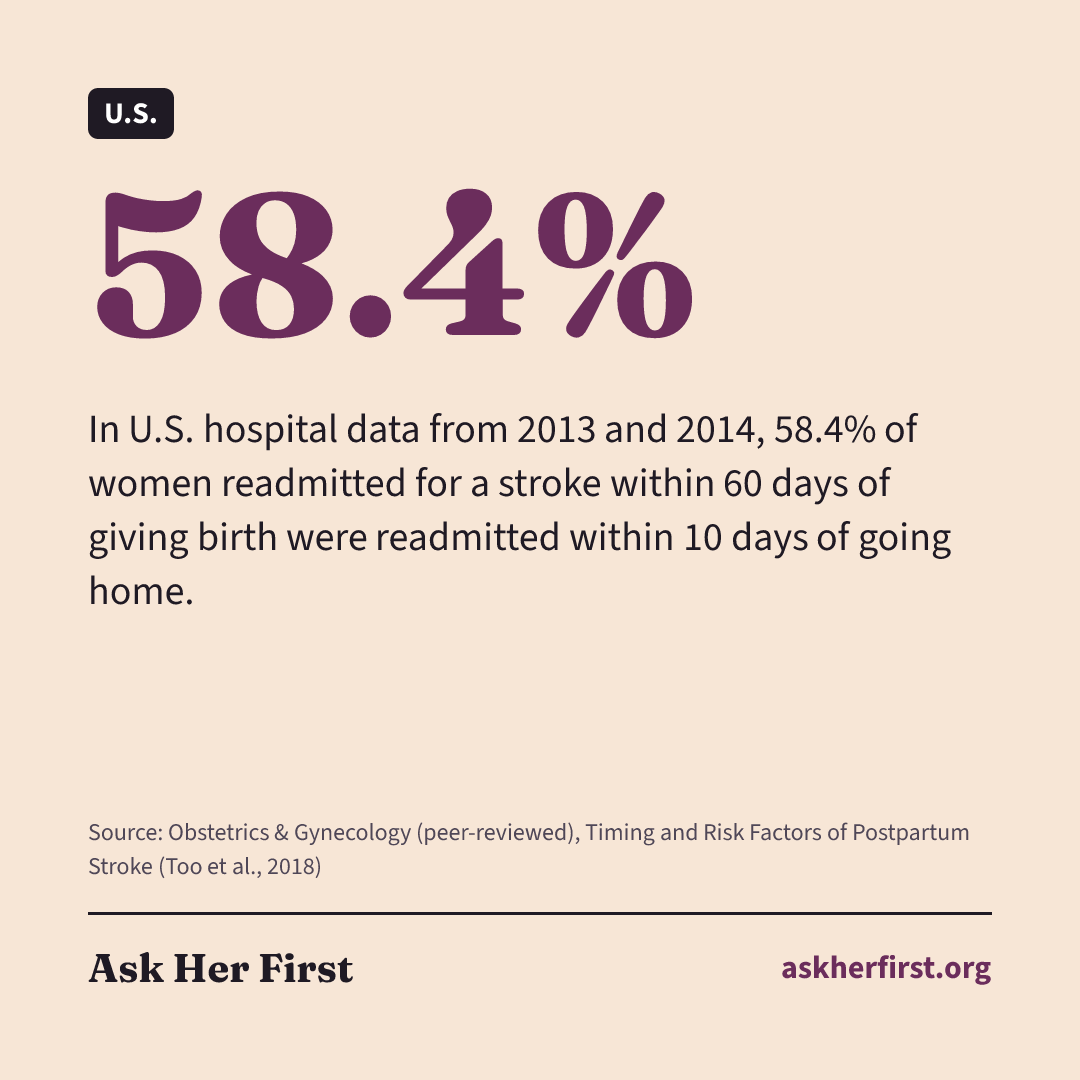
The days after leaving the hospital matter. In U.S. hospital data from 2013 and 2014, 58.4% of women readmitted for a stroke within 60 days of giving birth were readmitted within 10 days of going home.14 In that study, most women readmitted for stroke after birth did not have a high blood pressure disorder, although those who did had a higher risk.14 The AHA statement notes that diagnosing stroke in pregnancy is still challenged by delayed recognition.6
A severe headache, vision changes, and other urgent warning signs during pregnancy and the year after birth are covered in our guide Urgent warning signs during pregnancy and after birth. Preeclampsia can also raise stroke risk for years afterward: see After preeclampsia or gestational diabetes.
Risk factors that affect women
Many stroke risk factors are shared by everyone. MedlinePlus lists high blood pressure as the primary risk factor, along with diabetes, heart disease, smoking, a personal or family history of stroke or TIA, and older age.8 Atrial fibrillation, a type of irregular heartbeat, and other heart diseases can cause blood clots that lead to stroke.8 If you’ve already had a stroke or a TIA, your chances of having another stroke are higher.15
CDC says women of all ages are more likely than men to die from stroke, and that pregnancy and the use of birth control pills pose special stroke risks for women.15 NHLBI notes that at younger ages men are more likely than women to have a stroke, but because women tend to live longer, their lifetime risk is higher.9 OWH lists risk factors unique to women: problems during pregnancy like gestational diabetes or preeclampsia, using hormonal birth control while smoking, and using menopausal hormone therapy.16
Birth control pills and other combined methods
The American College of Obstetricians and Gynecologists (ACOG) says combined hormonal methods (the pill, patch, and ring that contain estrogen and progestin) are safe for most people but are linked with a small increased risk of deep vein thrombosis, heart attack, and stroke.17 ACOG says the risk is higher for people who:17
- Are older than 35 and smoke more than 15 cigarettes a day
- Have multiple risk factors for heart disease, such as high cholesterol, high blood pressure, and diabetes
- Have a history of stroke, heart attack, or deep vein thrombosis
- Have a history of migraine with aura
If you use one of these methods and any of this applies to you, it’s worth raising with your clinician, who can talk through other options.
Migraine with aura
An aura is a sensation just before a migraine attack starts, such as flashing lights, seeing spots, or dizziness.17 OWH says having migraine with aura raises your risk of stroke, especially if you are younger than 55 or smoke, and that women who take hormonal birth control pills and have migraine with aura are also at risk.18 OWH also says the overall risk of stroke for otherwise healthy women who get migraine is still low, and suggests talking to your doctor about your stroke risk if you have migraine.18
Keep in mind that CDC lists a sudden severe headache with no known cause among the warning signs of stroke.2 Ask your clinician which headache changes should prompt a call to 911 for you.
Menopause and hormone therapy
OWH says menopause raises the risk of stroke, and that estrogen may help keep blood vessels relaxed and open.18 ACOG says both combined hormone therapy and estrogen-only therapy are linked with a small risk of stroke and blood clots, that the risk increases with age and other factors, and that patches, sprays, and rings may pose less risk than pills.19 Our guide Menopause hormone therapy explains how thinking about hormone therapy has changed, its benefits and risks, and the 2025–2026 label changes in detail.
Lowering your risk
Stroke prevention overlaps heavily with heart health.8 CDC calls high blood pressure a leading cause of stroke.15 OWH notes that high blood pressure and high cholesterol usually don’t cause symptoms, so women may not know their risk.20 MedlinePlus lists heart-healthy steps that may help prevent stroke: eating a heart-healthy diet, aiming for a healthy weight, managing stress, getting regular physical activity, quitting smoking, and managing blood pressure and cholesterol; if those aren’t enough, medicine may be needed.8
Our guide Protecting your heart: blood pressure, cholesterol, and heart disease risk covers blood pressure and cholesterol checks and what the numbers mean.
For pregnancy, CDC’s prevention advice includes not smoking, staying active, and working with your health care team.13 OWH says the best way to lower the risk of stroke during pregnancy is to control your stroke risk factors before you get pregnant.18
After a stroke: recovery and support
It can take weeks, months, or even years to recover from a stroke; some people recover fully, while others have long-term disabilities.21 Rehabilitation may include working with speech, physical, and occupational therapists.21 NHLBI says changes after a stroke can make people feel scared, anxious, and depressed, and suggests talking with your provider about how you feel; support groups and support from family and friends may help.21 For survivors of stroke during pregnancy or after birth, the AHA notes unique challenges such as caring for an infant and breastfeeding, and says they need support from a team of rehabilitation specialists.6
Having a stroke raises the risk of another one, so prevention continues after recovery.8 NHLBI says to call 9-1-1 if you have any signs of another stroke.21 If depression or anxiety follows, our guide Finding mental health care explains where to start.
What we don’t know yet
- Women may be treated later. A 2025 World Stroke Organization scientific statement says that, although acute stroke treatments work comparably in women and men, women are less likely to receive timely treatment and often face delays in recognition and access to care.22- Stroke in pregnancy needs more research. The AHA says current stroke guidelines offer limited guidance for pregnant and postpartum patients, and that inclusive clinical trials are urgently needed.6
- Guidance is being updated. The AHA and American Stroke Association’s 2024 primary prevention guideline added sex-specific recommendations for stroke screening and prevention that were not in its 2014 version.23 We could not retrieve the full text to summarize those recommendations here.
- Sources don’t all match. Agencies use different memory aids (B.E. F.A.S.T. and F.A.S.T.) and describe the treatment time window a little differently, as shown above. Some pages are older: several NHLBI stroke pages were last updated in 2023, and one OWH page on how stroke affects women was last updated in 2021.1,16
Questions to ask your doctor
- Given my blood pressure, cholesterol, and health history, what is my risk of stroke?
- Is my birth control a good fit for me if I smoke, have high blood pressure, or get migraine with aura?
- I get migraine with aura. What does that mean for my stroke risk, and which headache changes should make me call 911?
- I had preeclampsia or high blood pressure in pregnancy. How should we follow my blood pressure now?
- If I’m considering menopause hormone therapy, how does the type, dose, and form (pill or patch) affect my stroke risk?
- Which hospital near me is equipped to treat stroke?
- I had symptoms that went away. Could it have been a TIA, and what follow-up do I need?
This article summarizes published research and official health information. It has not been reviewed by a clinician and is not medical advice. How we source.
A printout or saved PDF is a copy someone else could find.