

Menopause is not a disease or a disorder; the National Institute on Aging (NIA) calls it a normal part of aging for women.4 Some women have few or no symptoms, while for others the transition brings hot flashes, trouble sleeping, pain during sex, mood changes, or forgetfulness.4 This guide covers the basics: what the stages are, when they tend to happen, which changes are common, which ones deserve a checkup, and where to read more about treatment.
Perimenopause, menopause, and postmenopause
Perimenopause. The time leading up to menopause is called perimenopause, or the menopausal transition.4 The World Health Organization (WHO) says it starts when the first signs appear, usually changes in the menstrual cycle, and ends one year after the final period.5 During this time, the ovaries’ production of estrogen and progesterone declines greatly, and these changes may explain the symptoms some women have.4
Menopause. You have reached menopause only after a full year since your last period, meaning no bleeding, including spotting, for 12 months in a row.6
Postmenopause. The years after that point are the postmenopausal period, and the FDA notes that women often spend many years of their lives in it.7
It can be hard for you and your doctor to tell whether you are in the transition.4 The Office on Women’s Health (OWH) says providers don’t usually recommend a blood test for hormone levels unless there is a medical reason, such as periods stopping before age 40, because for most women hormone levels go up and down unpredictably during the transition.6 WHO also notes that some women have already stopped having periods before menopause, for example after certain surgeries or while using some hormonal contraceptives, and may still notice other changes of the transition.5
When it happens and how long it lasts
Official sources give slightly different numbers, partly because they describe different things:
- Average age of menopause. NIA and OWH put it at 52 in the United States.4,6 ACOG gives 51.8,9
- Usual age range. OWH says the range is usually between 45 and 58.6 The Menopause Society calls 46 to 55 the normal range.2 WHO says natural menopause generally happens between 45 and 55 worldwide.5
- When perimenopause starts. NIA says most women begin the transition between 45 and 55.4 OWH says it usually starts in the mid- to late 40s, and ACOG says estrogen levels can begin to fluctuate in a woman’s 30s and 40s.6,8
- How long perimenopause lasts. OWH says it can last two to eight years before periods stop, and about four years for most women.6
- How long symptoms last. NIA says symptoms related to menopause can last between two and eight years, with timing and symptoms that vary a lot from woman to woman.4 Hot flashes can last longer than that; see Common symptoms below.
Early, premature, and surgical menopause
Menopause before age 40 is called premature menopause, and between 40 and 45 it is called early menopause.3 About 3 in 100 women go through menopause before age 40, which is called premature menopause, according to The Menopause Society.2 About 5% of women naturally go through early menopause, between ages 40 and 45, according to the HHS Office on Women's Health.3
Early or premature menopause can happen on its own for no clear reason, or because of certain surgeries, medicines, or health conditions, including chemotherapy or pelvic radiation, some autoimmune diseases, and HIV that is not well controlled.3 Family history and smoking also make it more likely.3
Surgical menopause. If both ovaries are removed and you are not taking hormones, your periods stop and you may have menopause symptoms right away.4 OWH says these symptoms can be strong.3 A hysterectomy that leaves the ovaries in place is different: your periods stop, but you are not menopausal, because the ovaries keep making hormones.3
Primary ovarian insufficiency (POI). Premature menopause is also medically called POI.3 The Menopause Society notes that women with POI may still ovulate now and then, so pregnancy is still possible, and it advises women younger than 40 who have missed three or more periods to see a health care professional.2
OWH says some women with early or premature menopause may have a higher risk of heart disease and osteoporosis, because they live longer without the health benefits of higher estrogen levels.3 If you think you may be reaching menopause early, OWH suggests talking with your health care provider.3
Common symptoms
Some women notice no changes except irregular periods, while others have many symptoms, some of them severe.8,10 Some changes at midlife may come from aging rather than menopause itself.4
- Changes in your period. Periods may come closer together or farther apart, be heavier or lighter, or be skipped.9 OWH says irregular periods may be your first sign of the transition, and suggests tracking them.6
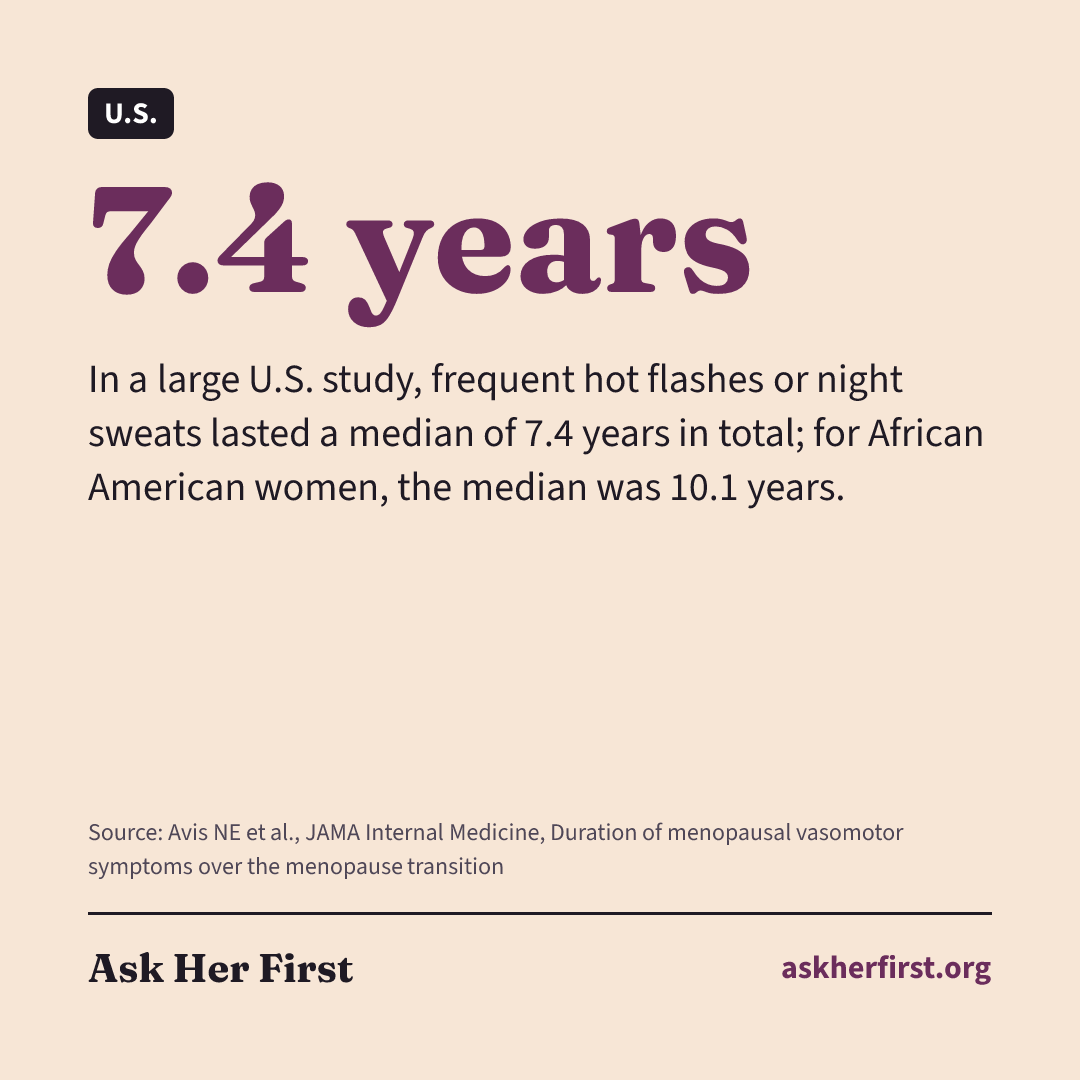
- Hot flashes and night sweats. A hot flash is a sudden feeling of heat, most often in the upper body and face; night sweats are hot flashes that happen at night and may disrupt sleep.4 They are among the most common symptoms of menopause, and for many women they last for many years after menopause.4 In a large U.S. study, frequent hot flashes or night sweats lasted a median of 7.4 years in total; for African American women, the median was 10.1 years.1
- Vaginal and urinary changes. Lower estrogen can make the vulva and vagina thinner, drier, and less elastic, which can cause pain with sex, burning, itching, or irritation.11 The Menopause Society calls this group of changes the genitourinary syndrome of menopause (GSM), and says it can also include urinary symptoms such as urgency, burning with urination, and more urinary tract infections.10 Unlike hot flashes, which generally improve over time, GSM often worsens without treatment.10 Read more: vaginal dryness and genitourinary syndrome of menopause.
- Mood changes. You might feel moodier or more irritable, and scientists don’t know exactly why.4 OWH says the risk of depression and anxiety is higher around menopause.12 Read more: Perimenopause and mental health.
- Memory and focus. The Menopause Society says “brain fog” during perimenopause is very common, that changes in thinking are usually mild, and that dementia at midlife is very rare.11
- Other changes. NIA lists joint and muscle aches, a larger waist, losing muscle and gaining fat, and thinner, drier skin.4
Sleep problems
Around midlife, some women have trouble falling asleep, wake too early, or wake up because of night sweats or a need to urinate.4 In the Study of Women’s Health Across the Nation (SWAN), a long-term NIH-funded study, trouble falling asleep and staying asleep became more likely as women moved through the transition, and more frequent hot flashes were linked with more sleep problems.13 NIA says hot flashes, especially night sweats, and mood changes, especially depression, can contribute to poor sleep.14
NIA’s suggestions include keeping a regular sleep schedule, keeping the bedroom at a comfortable temperature, avoiding screens in the bedroom, avoiding large meals and late caffeine, and remembering that alcohol makes it harder to stay asleep.14 If those changes aren’t enough, NIA says cognitive behavioral therapy for insomnia has been shown to help women with menopausal symptoms sleep better.14 It says over-the-counter and prescription sleep aids may help for a short time but are not a cure and should not be used long term.14
OWH suggests talking with your provider about sleep problems, since many women develop sleep apnea or insomnia, and notes that treating hot flashes that disrupt sleep usually improves sleep.12
Bleeding changes and bleeding after menopause
Changes in your period are normal as you near menopause, but ACOG says you should still talk with your ob-gyn about them, because abnormal bleeding can sometimes be a sign of a health problem.9 ACOG says it is not normal to have:9
- bleeding or spotting between periods
- bleeding or spotting after sex
- heavy bleeding during your period
- bleeding that is heavier or lasts more days than usual
- bleeding after menopause
Any bleeding after menopause needs a checkup. OWH says that if you have any vaginal bleeding after menopause, you should see a health care provider as soon as possible, because it is not normal and can mean a serious health problem.6 The FDA says it may be a sign of an urgent medical problem.7 That includes spotting or light bleeding.12
Causes range from noncancerous growths called polyps and a thinning or thickening of the uterine lining to endometrial cancer.9 Bleeding is the most common sign of endometrial cancer after menopause, and when it is found early, most cases can be treated successfully.9 Hormone therapy, infections, and some medicines can also cause bleeding after menopause.9
If your periods are heavy, see our guide to heavy periods and iron deficiency.
Birth control during perimenopause
You can still get pregnant during perimenopause, even after missing a period for a month or a few months, because you may still ovulate some months.6 NIA, OWH, and WHO say that if you don’t want to get pregnant, keep using birth control until a full 12 months after your last period.4,5,6 The FDA says not to stop birth control based on a positive result from a home menopause test kit.7
Hormonal birth control can hide the signs of menopause.10 For that reason, The Menopause Society says many clinicians recommend continuing hormonal contraception until the mid-50s, unless a woman chooses a permanent option.10 Ask your provider when it is safe for you to stop.7
Longer-term changes: bones and heart
Bones. ACOG says women lose bone more rapidly during the first 4 to 8 years after menopause because of lower estrogen, and too much bone loss raises the risk of osteoporosis and broken bones, most often in the hip, wrist, and spine.8 Osteoporosis is called a “silent disease” because many people notice nothing until a bone breaks.15 The U.S. Preventive Services Task Force (USPSTF) recommends osteoporosis screening for women 65 or older, and for postmenopausal women younger than 65 who are at increased risk for a fracture, as estimated by a clinical risk assessment (final recommendation, January 14, 2025).16 Read more: Osteoporosis and bone health after menopause.
Heart. ACOG says women lose much of estrogen’s protection against heart attack and stroke after menopause, at a time of life when risk factors such as high cholesterol, high blood pressure, and inactivity are also more common.8 A 2020 American Heart Association scientific statement describes the menopause transition as a time of accelerating heart disease risk and calls midlife a critical window for prevention.17 The Menopause Society says most heart disease in women happens in the years after menopause, and that premature menopause is an established risk factor.18 Heart attack symptoms in women can differ from what many people expect: read Heart attack symptoms in women.
Read more: Protecting your heart: blood pressure, cholesterol, and heart disease risk
What helps
Many women find that they don’t need treatment for menopause symptoms.4 For those who do, options include lifestyle changes, nonhormonal medicines, and hormones, and NIA suggests talking through your symptoms, history, and preferences with your doctor and reviewing the plan every year.4
Everyday measures
For hot flashes, NIA suggests dressing in layers, using a fan, keeping the bedroom cool, avoiding alcohol, spicy foods, and caffeine, quitting smoking, and aiming for a healthy weight.19 OWH suggests similar steps, plus noting what seems to trigger your hot flashes.12
The evidence behind them is limited, though. The Menopause Society’s 2023 review of nonhormone treatments found only limited or inconsistent evidence for cooling techniques, avoiding triggers, exercise, and yoga as treatments for hot flashes, and did not recommend them for that purpose.20 It did recommend weight loss, based on limited evidence and expert opinion.20 The Menopause Society adds that this doesn’t mean such measures have no value: a healthy diet, regular exercise, and stress management may play a vital role in preventing chronic disease and in overall health.21
For vaginal dryness, ACOG says over-the-counter vaginal moisturizers and lubricants can help; they contain no hormones.8
Hormone therapy
The Menopause Society’s 2022 position statement says hormone therapy is the most effective treatment for hot flashes and night sweats and for genitourinary symptoms, and that it has been shown to prevent bone loss and fracture.22 It says the risks depend on the type, dose, length of use, how it is taken, when it is started, and whether a progestogen is used, and that the balance is favorable for bothersome hot flashes in women without contraindications who are under 60 or within 10 years of menopause.22 For vaginal symptoms alone, low-dose estrogen placed in the vagina is one option.8,22 For women still having periods, The Menopause Society notes that hormonal birth control is often used to treat hot flashes, especially when contraception is needed too.11
The FDA began changing hormone therapy labels in November 2025 and approved the first updated labels in February 2026.23,24 Our guide explains what changed and where experts still disagree: Menopause hormone therapy: what changed and what we know.
Nonhormonal options
For women who cannot or choose not to take hormones, the FDA has approved three nonhormone medicines for menopause symptoms.25 The Menopause Society’s 2023 statement also recommends cognitive behavioral therapy, clinical hypnosis, certain antidepressants (SSRIs and SNRIs), gabapentin, and fezolinetant for hot flashes, based on good and consistent evidence.20 Our hormone therapy guide describes each approved medicine and its safety warnings.
Supplements. The Menopause Society does not recommend supplements or herbal remedies for hot flashes.20 NIA says black cohosh, DHEA, and soy isoflavones are not proven to work, and some carry risks such as liver damage.19 If you take one, ACOG suggests telling your health care professional.8
Mood and mental health
If mood changes are affecting you, NIA suggests talking with a primary care provider or a mental health professional, and says treatments are available.4 OWH says mood changes are not the same as depression, which is a serious illness that needs its own treatment.12 Our guide to perimenopause and mental health covers the research and treatment options in depth.
What we don’t know yet
- Why hot flashes happen. NIA says it isn’t clear why hot flashes are so common during the transition, though they are likely related to changing hormones.4
- How long symptoms will last for you. Estimates differ by source and by what they measure, from NIA’s two to eight years for symptoms overall to SWAN’s median of more than seven years for frequent hot flashes.1,4 In SWAN, women whose frequent hot flashes started while their periods were still regular, or early in the transition, had them the longest.1
- Why experiences differ so much. NIA says timing and symptoms are likely shaped by genetics and by factors such as race and ethnicity, culture, lifestyle, and environment.4 For example, NIA notes that compared with White women, Black women are more likely to reach menopause early, have more symptoms, and have them for longer.4
- Primary ovarian insufficiency. The Menopause Society says much is still unknown about POI, which makes it hard to predict what will happen.2
- Older data and missing groups. SWAN, a major source of what we know, collected its data from 1996 to 2013.1 WHO notes there is little data on how trans and gender-diverse people experience menopause.5
- Changing advice. In November 2025, the FDA asked makers of hormone therapy to remove label advice to use the lowest effective dose for the shortest time.23 Some official consumer pages still repeat that older advice, so it helps to check the date on anything you read.7,19
Questions to ask your doctor
- Could my symptoms be perimenopause, or could something else be causing them?
- Is my bleeding pattern normal for this stage, or should it be checked?
- I’ve had bleeding or spotting after going a year without a period. What tests do I need?
- Do I still need birth control, and when is it safe to stop?
- My periods stopped before 40 (or 45). What does that mean for my bones, heart, and fertility?
- Which options for hot flashes, sleep, or vaginal dryness fit my health history?
- Should I have a bone density test, and when?
- What should I watch for with my heart health now?
This article summarizes published research and official health information. It has not been reviewed by a clinician and is not medical advice. How we source.
A printout or saved PDF is a copy someone else could find.